


A will and a trust both say who gets your property when you die. The difference is how that property gets there. A will goes through probate, a public court process that can take months. A funded living trust lets a person you choose hand over assets privately, without a judge.
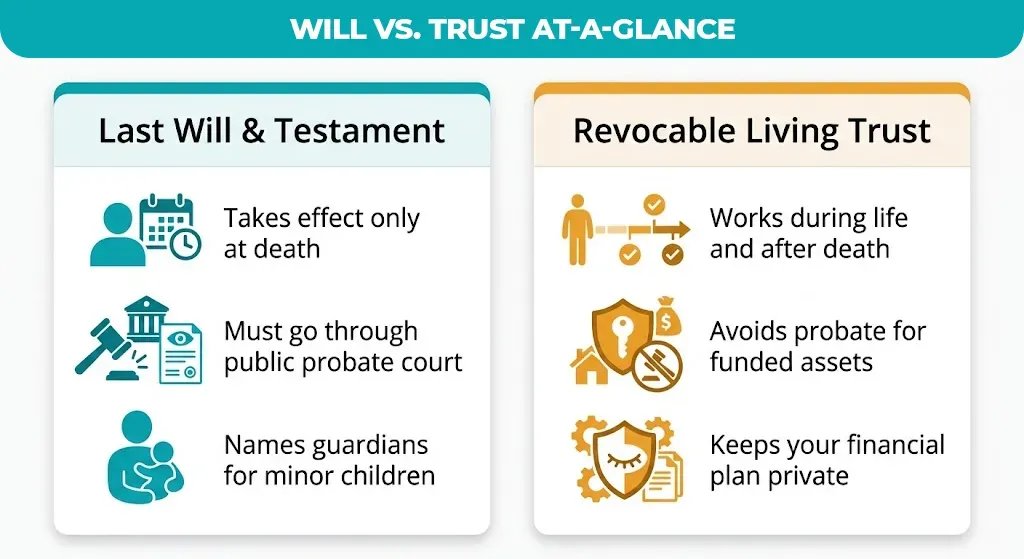
Quick answer: A will takes effect at death and must go through probate court. A revocable living trust works during your life and after it, avoids probate for the assets you put in it, and keeps your plan private. Most people with a trust also need a pour-over will.
What Is a Will vs Trust?
A will is a document that tells a probate court how to distribute your assets after you die. A revocable living trust is an arrangement that owns your assets while you’re alive and passes them to your beneficiaries after death, privately and usually without court involvement. A will does nothing until death. A trust works as soon as you sign it and move assets into it.
The core distinction
| Question | Last will and testament | Revocable living trust |
| When does it work? | Only at death | Immediately, during life and after death |
| Who manages assets after death? | Executor, under court supervision | Successor trustee, privately |
| Goes through probate? | Yes | No, for assets titled in the trust |
| Public record? | Yes, once filed in probate | Generally no |
| Covers incapacity? | No | Yes, the successor trustee steps in |
| Names guardians for minor children? | Yes | No (you need a will for this) |
So what is the benefit of a trust vs a will? In short: probate avoidance, privacy, and incapacity protection. The benefit of a will is lower upfront cost and the ability to name guardians.
Essential clarification: living trust vs. living will vs. testamentary trust
The names sound alike, but these are three different tools. Mixing them up is one of the most common estate planning mistakes.
• Living will: a medical document, not a financial one. It records your end-of-life healthcare wishes, such as life support preferences. It’s often part of an advance healthcare directive.
• Living trust (revocable living trust): a financial arrangement that holds title to your assets during your lifetime and distributes them at death. It doesn’t make medical decisions.
• Testamentary trust (sometimes called a will trust): a trust written inside your will. It’s created only after you die and after the will goes through probate.
So what is a living will vs living trust? One covers your body, the other covers your property. A complete plan often includes both.
Core Legal Mechanics: How Wills and Living Trusts Work
A will is a set of instructions for a court to carry out after you die. A living trust is an arrangement you set up and manage while you’re alive, with a successor trustee ready to take over. That difference in timing explains almost every other difference between them.
How a last will and testament works
A will names who receives your property, who carries out your wishes (the executor), and who raises your minor children (the guardian). It has no legal effect until you die and a court admits it to probate.
Key parts of a will:
• Executor (personal representative). Files the will with the probate court, inventories assets, pays debts and taxes, and distributes what’s left under court oversight.
• Beneficiaries. The people and organizations that receive your property.
• Guardian for minor children. Only a will can formally nominate a guardian. A trust can’t do this.
• Legal execution. Most states require a will to be signed in front of witnesses, commonly two. Many allow a self-proving affidavit, signed before a notary, which speeds up probate.
A will only controls property in your individual name with no beneficiary designation. Life insurance, retirement accounts, jointly owned property, and payable-on-death accounts pass outside the will to whoever is named on them.
How a revocable living trust works
A revocable living trust has three roles: the grantor who creates it, the trustee who manages it, and the beneficiaries who benefit from it. In most family trusts, you fill all three roles while you’re alive.
| Role | Also called | Who it usually is | What they do |
| Grantor | Settlor, trustor | You (and your spouse, for a joint trust) | Creates the trust, funds it, and can change or revoke it |
| Trustee | Initial trustee | You, during your lifetime | Manages trust assets |
| Successor trustee | n/a | A trusted adult, family member, or professional | Takes over at your incapacity or death |
| Beneficiaries | n/a | You during life, then your heirs | Receive the benefit of trust assets |
Because it’s revocable, you can amend or cancel it at any time while you have capacity. That’s what a lifetime trust vs will usually means: one plan that works from the day you sign it, not just after you die.
Funding the trust: why an unfunded trust fails
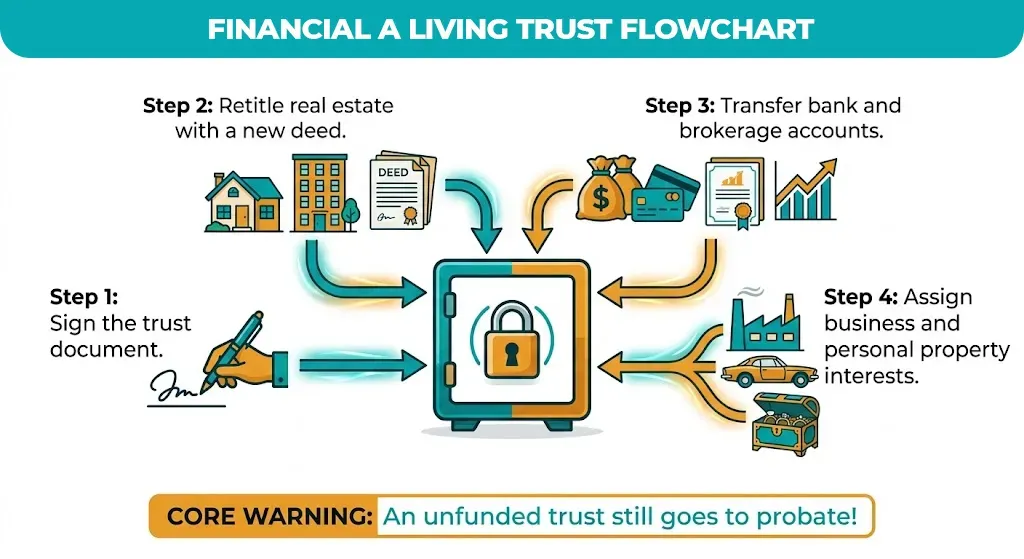
A living trust only avoids probate for assets that are actually titled in the trust’s name. Signing the trust document isn’t enough. You have to fund it.
Funding a trust usually means:
• Real estate: signing and recording a new deed transferring the property to yourself as trustee.
• Bank and brokerage accounts: retitling them in the trust’s name, or naming the trust as payable-on-death beneficiary.
• Business interests: assigning LLC or partnership interests to the trust.
• Personal property: signing a general assignment of tangible items to the trust.
• Retirement accounts: generally not retitled. Name beneficiaries directly, and get tax advice before naming a trust.
Note: An unfunded trust is one of the most common living trust mistakes. If the house is still in your personal name when you die, it goes through probate, even with a perfectly written trust.
The safety net: pour-over will vs testamentary trust
A pour-over will catches any assets left outside your living trust and “pours” them into it at death. A testamentary trust is created by your will and only exists after probate. They solve different problems.
• Pour-over will: a backup will used with a living trust. It names a guardian for minor children and sends forgotten assets into the trust. Those forgotten assets still go through probate, but they end up governed by your trust’s terms.
• Testamentary trust: a trust written into a will, often to hold an inheritance for minor children until a set age. It goes through probate first, and the probate court may supervise it afterward in some states.
So what is a testamentary trust vs pour over will? The pour-over will supports an existing living trust. The testamentary trust is the trust, created only at death.
Master will vs. living trust comparison matrix
| Feature | Last will and testament | Revocable living trust | Operational winner |
| Takes effect | At death | When signed and funded | Trust |
| Probate | Required for will assets | Avoided for funded assets | Trust |
| Privacy | Public once probated | Generally private | Trust |
| Incapacity planning | None | Successor trustee manages assets | Trust |
| Guardians for minors | Yes | No | Will |
| Upfront cost | Lower | Higher | Will |
| Ongoing upkeep | Update after life changes | Fund new assets, update after life changes | Will |
| Court supervision of executor/trustee | Yes | Generally no | Depends |
| Out-of-state real estate | Ancillary probate likely | Avoids ancillary probate if titled in trust | Trust |
| Ease of contest | Contested in an open court case | Can be contested, but no court case is already open | Trust (slightly) |
Key Differences: Probate, Privacy, Incapacity, & Costs
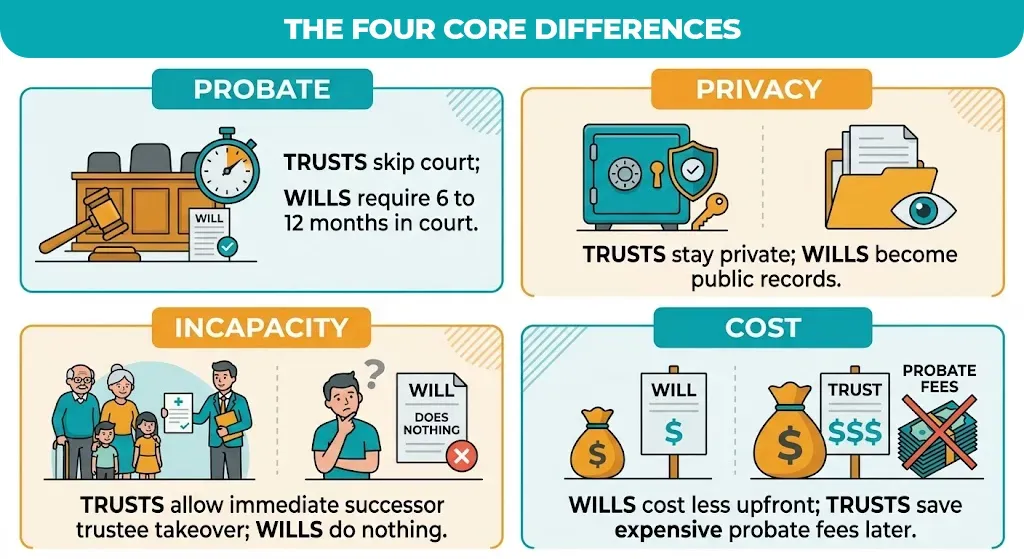
The four differences that matter most are probate, privacy, incapacity, and cost. A trust wins on the first three. A will wins on upfront cost, though probate can erase that advantage.
Factor 1: Probate court and timeline drag
Probate is the court process for validating a will, paying debts, and distributing assets. It typically takes 6 to 12 months, and complex estates can take longer. A funded living trust skips it for trust assets.
Typical probate timelines, per LegalZoom (updated August 2025):
| State | Typical full probate timeline |
| California | 9–18 months |
| New York | 7–12 months |
| Florida | 6–12 months (formal administration) |
| Texas | 4–8 months (independent) to 8–15 months (dependent) |
Creditor claim periods alone usually run 3 to 6 months, and California’s is 4 months. Will contests, multi-state property, and court backlogs add more time.
Trust administration usually moves faster. A successor trustee can typically access accounts and manage property within weeks of the death, while still paying debts, filing tax returns, and keeping beneficiaries informed.
Note: Many states offer simplified probate or small estate affidavits below a set dollar limit. If your estate is small, a will may involve little court time at all.
Factor 2: Privacy vs. public record
A will becomes a public court record once it’s filed for probate. A living trust generally stays private. In probate, the will and often the inventory of assets can be viewed by anyone who requests the file.
With a trust, beneficiaries and certain parties have a right to information, but the trust document usually isn’t filed with any court. That privacy matters for families with valuable property, business interests, or relatives likely to dispute the plan.
Factor 3: Incapacity planning
A will does nothing if you become incapacitated. A living trust lets your successor trustee manage trust assets immediately, without a court-ordered conservatorship or guardianship.
Without a trust or durable power of attorney, your family may have to ask a court to appoint someone to manage your finances. That process can be slow, costly, and public.
A complete incapacity plan usually includes:
• A revocable living trust for titled assets.
• A durable financial power of attorney for assets outside the trust (retirement accounts, tax matters).
• A healthcare power of attorney to name a medical decision-maker.
• A living will for end-of-life treatment preferences.
Factor 4: Financial costs
A will costs less to create. A trust costs more upfront but can cost much less to settle.
| Cost item | Will-based plan | Living trust plan |
| Online / DIY | Lower-cost will packages available | About 400–1,000 |
| Attorney-prepared | Often a few hundred to about $1,000 for a simple will (varies widely) | About 1,500–4,000, more for complex estates |
| Settlement after death | Probate court fees, attorney and executor fees | Trustee time, attorney help if needed, no probate court fees for trust assets |
Trust ranges: LegalZoom 2026 price guide. Will fees vary by attorney and region; LegalZoom cites an average estate attorney rate of about $370 per hour.
Probate costs are commonly estimated at 3%–7% of estate value, according to estate planning professionals cited by Trust & Will. California sets fees by statute. Under Probate Code § 10810, the attorney’s fee is 4% of the first $100,000, 3% of the next $100,000, and 2% of the next $800,000, and the executor can receive the same amount.
California statutory fees on a $500,000 estate:
Attorney: 4% x $100,000 = $4,000
3% x $100,000 = $3,000
2% x $300,000 = $6,000
Total = $13,000
Executor: same schedule = $13,000
Combined statutory fees = $26,000 (5.2%), before court and other costs
Living trust vs. living will vs. testamentary trust matrix
| Document type | Primary function | Takes effect when? | Bypasses probate? | Handles medical directives? |
| Revocable living trust | Holds and transfers assets | When signed and funded | Yes, for funded assets | No |
| Living will | States end-of-life medical wishes | When you can’t communicate and conditions are met | Not applicable | Yes |
| Testamentary trust | Holds inheritance under a will | After death and probate | No | No |
| Pour-over will | Moves leftover assets into a trust; names guardians | At death | No (assets pass through probate) | No |
| Last will and testament | Distributes assets; names executor and guardians | At death | No | No |
Real Estate, Wealth Transfer, & Specific Scenarios
A house is where the will vs trust decision usually matters most. Real estate is often the largest asset in an estate, it can’t be retitled without a deed, and property in another state can trigger a second probate case.
Is it better to inherit a house or put it in a trust?
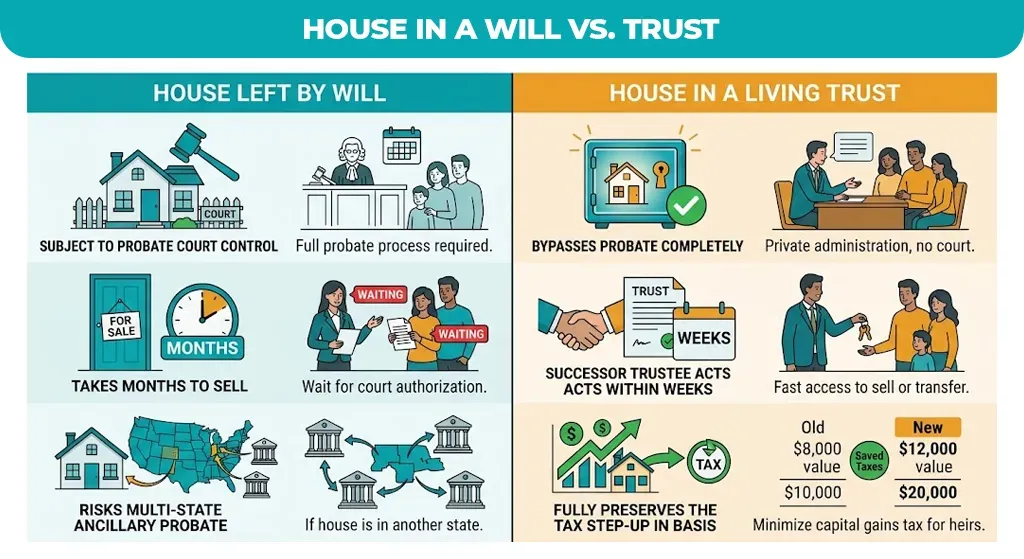
For most families, putting the house in a revocable living trust is better than leaving it by will, because the heirs get the same tax treatment without probate. The step-up in basis works the same way either way.
Step-up in basis (IRC § 1014). When you inherit property, your tax basis generally becomes its fair market value on the date of death. Section 1014(b)(2) extends this to property the decedent transferred during life to a trust they could revoke. So a house in a revocable living trust still gets the step-up.
Example (hypothetical):
Parent bought house: $150,000
Value at parent’s death: $450,000
Child’s stepped-up basis: $450,000
Child sells soon after for: $455,000
Taxable gain: $5,000 (not $305,000)
Note: This is different from giving the house away while you’re alive. A lifetime gift usually carries over your original basis, which can mean a much larger capital gains tax when your child sells.
Ancillary probate. Real estate is subject to the probate laws of the state where it’s located. If you own a vacation home or rental property in another state and leave it by will, your executor may need to open a second, ancillary probate case there, with added court fees and an out-of-state lawyer. Titling that property in a living trust can avoid it.
Mortgage due-on-sale clauses (Garn-St. Germain Act). Moving a home into a trust doesn’t usually let your lender call the loan. Under 12 U.S.C. § 1701j-3(d)(8), lenders can’t enforce a due-on-sale clause on a transfer into an inter vivos (living) trust in which the borrower is and remains a beneficiary, as long as occupancy rights don’t change. The protection applies to residential property with fewer than five dwelling units.
What is a living trust on a house vs will?
| Step | House left by will | House in a living trust |
| At death | Executor files for probate | Successor trustee takes over |
| Court involvement | Probate court must authorize the executor | Generally none |
| Time before sale or transfer | Often months, after appointment and creditor period | Often weeks |
| Out-of-state property | Ancillary probate likely | Avoided if titled in the trust |
| Step-up in basis | Yes | Yes |
| Mortgage | Stays in place; Garn-St. Germain also limits due-on-sale enforcement on transfers to relatives at death | Stays in place; Garn-St. Germain protects the transfer into the trust |
| Paperwork during life | None | New deed recorded to the trust |
Some states also allow a transfer-on-death (TOD) deed, which passes a house outside probate without a trust. It’s simpler, but it doesn’t cover incapacity or give a trustee power to manage the property.
At what point is a trust better than a will?
A trust usually becomes better than a will when any of these apply:
• You own real estate, especially in more than one state.
• Your probate estate would exceed your state’s small estate limit, so full probate would apply.
• You live in a high-cost probate state, such as one with statutory percentage fees.
• Privacy matters to you or your family.
• You want incapacity protection without a court conservatorship.
• You have a blended family, a beneficiary with special needs, or heirs who shouldn’t receive everything at once.
• You own a business that needs to keep running if you die or become incapacitated.
A simple will may be enough if you’re young, rent your home, have few assets, and most of what you own already passes by beneficiary designation.
What are the disadvantages of a trust vs. a will?
The main disadvantages of a trust are higher upfront cost, the work of funding it, and ongoing upkeep.
• Cost: trust packages typically cost several times more than a simple will.
• Funding: you must retitle assets and record deeds. Assets you forget still go through probate.
• Maintenance: new accounts or property must be added to the trust over time.
• Refinancing friction: some lenders ask you to take the home out of the trust to refinance, then put it back.
• No guardian nominations: you still need a will for minor children.
• No estate tax savings by itself: a revocable trust doesn’t reduce federal estate tax. The 2026 federal basic exclusion is $15 million per person, so most families won’t owe it anyway.
• No creditor protection during life: because you can revoke it, your creditors can generally still reach the assets.
Buyer’s Blueprint: Building a Complete Estate Plan
A complete estate plan usually combines a living trust, a pour-over will, powers of attorney, a living will, and up-to-date beneficiary designations. Each document covers a gap the others leave open.
Do I need both a will and trust?
Yes, almost everyone with a living trust also needs a pour-over will. The trust handles the assets you’ve funded into it. The will does two jobs the trust can’t:
1. Names guardians for minor children.
2. Catches leftover assets you didn’t title in the trust, such as a car, a refund check, or an account opened late in life, and moves them into the trust.
Think of the trust as the main plan and the pour-over will as the safety net.
Step-by-step blueprint
Step 1 Audit your assets
List real estate, bank and brokerage accounts, retirement accounts,
life insurance, business interests, vehicles, and valuables.
Note how each is titled and who is named as beneficiary.
Step 2 Decide: will only, or trust + pour-over will
Use the threshold triggers above. Consider your state’s probate cost.
Step 3 Choose your people
Executor, successor trustee, guardian for minors, financial agent
(power of attorney), and healthcare agent. Name backups.
Step 4 Sign the documents correctly
Follow your state’s witness and notary rules.
Step 5 Fund the trust
Record new deeds, retitle accounts, assign business interests.
Step 6 Update beneficiary designations
Life insurance and retirement accounts pass by beneficiary form,
not by your will or trust. Make sure they match your plan.
Step 7 Review every 3–5 years, and after major life events
Marriage, divorce, births, deaths, moves, or buying property.
Note: Wills and trusts are legal documents governed by state law. Have an estate planning attorney licensed in your state draft or review them.
Where life insurance fits in your estate plan
Life insurance passes directly to your named beneficiaries, outside probate, and can give your family cash while the rest of the estate is being settled. That cash can cover funeral costs, debts, taxes, and living expenses during probate or trust administration.
Common roles for life insurance in an estate plan:
• Liquidity: pay final expenses and bills so heirs don’t have to sell the house quickly.
• Equalizing inheritances: leave the house to one child and an equal policy benefit to another.
• Income replacement: protect a spouse and children if you die during working years with term life insurance.
• Lifetime coverage: whole life insurance for permanent needs.
• Final expenses: final expense insurance for funeral and end-of-life bills.
Premier Services Agency can help you choose the right coverage and beneficiary setup so your policy works with the will or trust your attorney prepares.
Conclusion:
A will is the minimum every adult should have, especially parents of minor children. A funded revocable living trust, paired with a pour-over will, is the stronger choice when probate avoidance, privacy, or incapacity planning matters.
| Your situation | Usually best fit |
| Young, renting, few assets | Simple will + beneficiary designations |
| Parents of minor children | Will (for guardians), plus a trust if you own a home |
| Homeowner | Living trust + pour-over will |
| Property in more than one state | Living trust to avoid ancillary probate |
| Blended family or special-needs heir | Trust with tailored distribution terms |
| Concerned about incapacity | Trust + durable power of attorney + living will |
| High-cost probate state | Living trust |
Whichever you choose, keep beneficiary designations current and review the plan after every major life event.
Protect Your Family Legacy with Premier Services Agency
A will or trust decides who gets your assets. Life insurance makes sure there’s cash to pay final bills and support your family while the estate is settled. Consult with Premier Services Agency to make sure your coverage fits your estate plan.
Premier Services Agency can help you:
• Compare life insurance options from multiple carriers.
• Choose between term coverage for working years and permanent coverage for lifelong needs.
• Set up beneficiary designations that match your will or trust.
• Cover funeral and final costs with burial insurance or final expense coverage.
Call (470) 650-0470 or request a free quote. There’s no obligation to buy.
Note: Premier Services Agency is an insurance agency and doesn’t draft wills or trusts or give legal advice. Work with an estate planning attorney licensed in your state for those documents.