


A 10-year term life insurance policy pays a fixed death benefit to your named beneficiary if you die within a ten-year period, in exchange for a locked-in premium that does not change during the term. It is the shortest common term length sold in the United States and typically the least expensive way to buy a meaningful amount of coverage, according to 2026 rate data from MoneyGeek’s carrier survey.
This guide explains what a 10-year term life insurance policy covers, what it costs by age and health class, how it compares to 20-year and 30-year term life insurance, and what happens when the ten-year period ends. You will also find a breakdown of the underwriting process, the regulatory protections built into every state-licensed policy, and answers to the most common questions about 10-year term coverage.
If you already know you want a short-term, budget-focused policy, understanding these mechanics will help you compare quotes accurately instead of guessing at coverage terms.
| Quick Answer: A 10-year term life insurance policy locks in a fixed death benefit and premium for exactly ten years. It is the cheapest term length available, averaging $34 to $41 per month for a healthy 40-year-old with $500,000 in coverage, per MoneyGeek’s 2026 carrier data. Coverage ends at year ten unless you renew, convert, or replace it. |
What Is 10 Year Term Life Insurance?
10-year term life insurance is a category of term life insurance, a broader class of policies that provide coverage only for a defined period rather than for life. Within that ten-year period, the policy is described as level term, meaning both the death benefit and the premium stay fixed from the day you buy the policy until the term expires.
If the insured person dies during the ten-year term, the insurer pays the death benefit directly to the named beneficiary, typically as a single lump sum. If the insured outlives the term, the coverage simply ends unless the policyholder renews, converts, or replaces it with a new application.
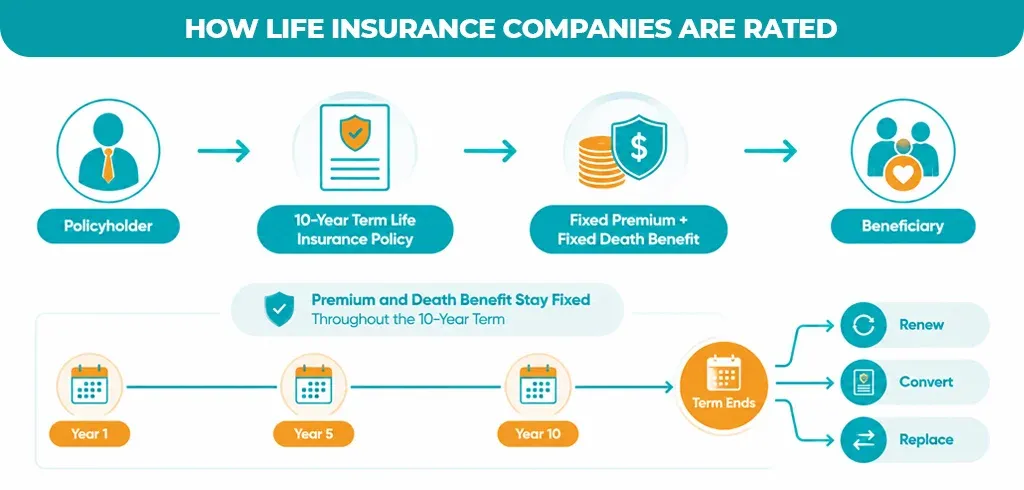
This structure differs from whole life insurance and other permanent policies, which are designed to last for the insured’s entire life and build a cash value component that the policyholder can borrow against. A 10-year term life insurance policy carries no cash value, which is one reason it costs substantially less per dollar of coverage than permanent products such as whole life insurance or final expense insurance.
How Much Does a 10 Year Term Life Insurance Policy Cost?
| Quick Answer: A 10-year term life insurance policy for a healthy 40-year-old averages $34 per month for women and $41 per month for men at $500,000 in coverage, according to MoneyGeek’s 2026 carrier survey. Rates are lower for younger, healthier applicants and rise with age, tobacco use, and larger coverage amounts. |
Cost is the main reason people search for 10-year term life insurance. Because the coverage window is short, insurers charge less than they would for a 20-year or 30-year term life insurance policy on the same applicant, since the statistical chance of a claim within ten years is lower.
Real 2026 carrier data illustrates the range of sample premiums:
| Age | Gender | Coverage Amount | Est. Monthly Premium | Source |
| 18 | Female | $500,000 | $22 | MoneyGeek, 2026 |
| 40 | Female | $500,000 | $34 | MoneyGeek, 2026 |
| 40 | Male | $500,000 | $41 | MoneyGeek, 2026 |
| 40 | Male | $1,000,000 | $54 | Ethos, 2025 |
| 45 | Male | $1,000,000 | $73 | Ethos, 2025 |
| 70 | Male | $500,000 | $600 | MoneyGeek, 2026 |
Several factors move the price of a 10-year term life insurance policy up or down:
- Age: Rates on a 10-year term life insurance policy are lowest in your 20s and rise every year after, according to PinnacleQuote’s 2026 rate charts.
- Health and tobacco use: MoneyGeek’s 2026 survey found that applicants in poor health pay an average of $46 per month for $500,000 in 10-year coverage, while smokers pay an average of $133 per month for the same coverage.
- Coverage amount: ChoiceMutual’s 2026 rate data shows a $100,000 10-year term policy running roughly $10 to $75 per month, while a $250,000 10-year term policy runs roughly $12 to $100 per month, depending on age and health.
- Carrier selection: Banner Life and Transamerica had the lowest average 10-year term rates in MoneyGeek’s 2026 survey, at about $30 per month, or $362 per year, for $500,000 in coverage.
- Coverage-to-cost ratio: eFinancial data cited by Progressive puts a $250,000 10-year term policy at roughly $24 to $31 per month for a healthy applicant between 20 and 40 years old.
| Key Takeaways: 10-year term life insurance is the least expensive term length for identical coverage, but the exact premium still depends heavily on your age, health class, tobacco use, and the carrier you choose, so a same-profile quote can vary by $10 or more per month between insurers. |
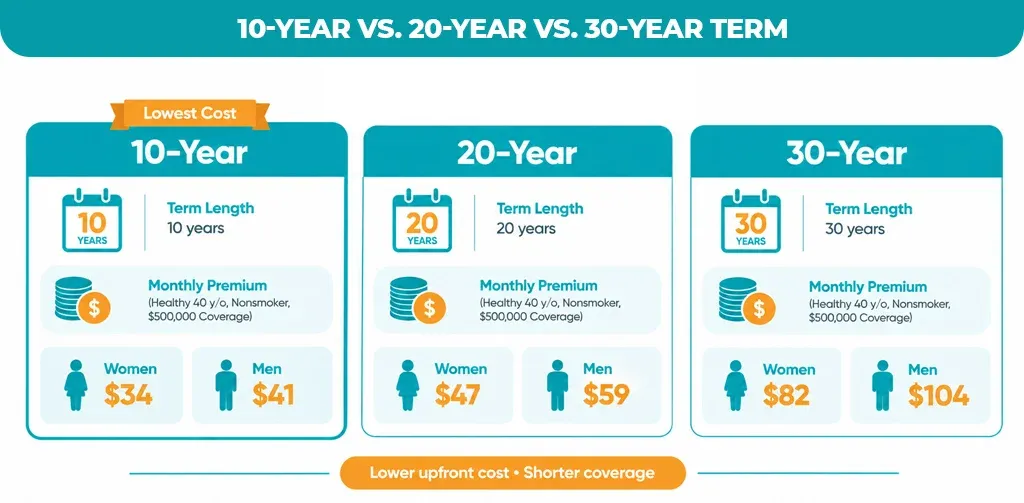
10-Year Term vs. 20-Year and 30-Year Term Life Insurance
| Term Length | Monthly Premium (Women) | Monthly Premium (Men) | Source |
| 10-year | $34 | $41 | MoneyGeek, 2026 |
| 20-year | $47 | $59 | MoneyGeek, 2026 |
| 30-year | $82 | $104 | MoneyGeek, 2026 |
All three figures above reflect a 40-year-old nonsmoker buying $500,000 in coverage, so the comparison is apples to apples. A 10-year term life insurance policy wins on upfront affordability every time, but MoneyGeek’s own analysis notes an important exception: a single 30-year term can end up cheaper across its full duration than three consecutive 10-year terms, because each renewal recalculates your premium using your age and health at that later date.
In practical terms, a ten-year term life insurance policy makes the most sense when your need for coverage genuinely has a ten-year horizon, not simply because the initial quote is the lowest one on the page.
Who Should Consider a 10 Year Term Life Insurance Policy?
A 10-year term life insurance policy tends to fit situations where the financial obligation being covered has a clear, roughly ten-year timeline:
- Paying off a specific debt with a ten-year payoff schedule, such as a business loan or a fixed-term portion of a mortgage
- Bridging the gap until a pension, Social Security benefit, or other retirement income is scheduled to begin
- Covering a co-signed loan or a child’s remaining years of financial dependency before they become financially independent
- Supplementing an employer’s group life insurance plan while building toward a longer-term coverage strategy
- Testing what coverage costs before committing to a longer 20-year or 30-year term life insurance policy
Pros and Cons of 10 Year Term Life Insurance
Advantages
- Lower monthly premium than any other common term length for the same coverage amount
- Fixed death benefit and premium for the full ten-year term
- Often convertible to a permanent policy without new medical underwriting, if the policy includes a conversion rider and it is exercised within the conversion window
- Comparatively straightforward underwriting for applicants in good health
Trade-offs
- Coverage ends after ten years, which may be before a mortgage or other long-term obligation is fully paid off
- Renewing after the term ends resets the premium using your age and health at that later date, which typically raises the cost substantially
- Standard 10-year term life insurance builds no cash value or savings component
- Buying a brand-new policy instead of renewing may require a fresh medical exam and full re-underwriting
How Underwriting Works for a 10 Year Term Life Insurance Policy
| Quick Answer: Most 10-year term life insurance applications place you into a risk class such as preferred, standard, or substandard based on age, health history, family history, and lifestyle. Insurers use these classes, not race, ethnicity, or credit score, to set your premium, according to underwriting research published by NerdWallet. |
When you apply for a 10-year term life insurance policy, the insurer evaluates your application through underwriting, the process carriers use to assess mortality risk. Depending on your age and the coverage amount requested, this may include a paramedical exam covering blood pressure, height and weight, and a blood or urine sample, or it may be handled through an accelerated, no-exam process for smaller policies.
Insurers typically sort applicants into tiers such as super preferred, preferred, and standard, with super preferred reserved for the healthiest, lowest-risk applicants. Because each insurer weighs health and lifestyle factors differently, the same person can receive a different risk class and therefore a different premium from one carrier to the next, which is why comparing multiple quotes matters.
What Happens When Your 10 Year Term Life Insurance Policy Ends
A standard 10-year term life insurance policy does not automatically continue once the ten-year period is over. Policyholders generally have three options at that point:
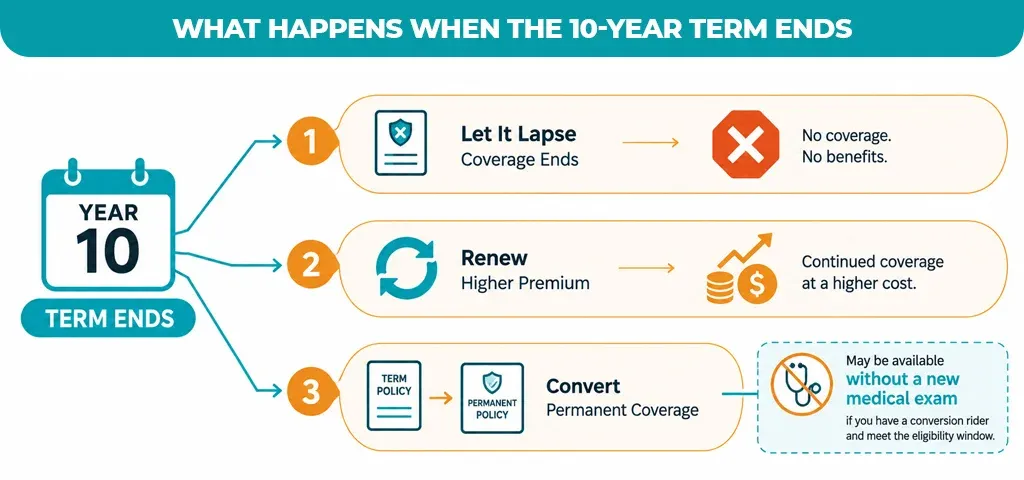
- Let the policy lapse. Coverage simply ends, and no further premiums are due, but there is no benefit if you die afterward.
- Renew the term. Many policies are guaranteed renewable for one or more additional terms, but the premium resets based on your age and often your health class at the time of renewal, which usually costs significantly more than your original rate.
- Convert to permanent coverage. If the original policy included a conversion rider and the conversion window has not closed, you may be able to convert some or all of the death benefit to a whole life insurance or other permanent policy without a new medical exam.
Some carriers also offer a return of premium rider, which refunds the premiums paid over the ten-year term if the policyholder outlives it, but this feature is not standard and increases the cost of the policy. Outside of that specific rider, a standard 10-year term life insurance policy has no cash value to withdraw or borrow against, so there is nothing to “cash out” at the end of a typical term.
Regulation and Insurer Financial Strength: What Protects You
| Quick Answer: In the United States, life insurance is regulated at the state level, with the National Association of Insurance Commissioners (NAIC) coordinating standards, financial oversight, and consumer protections across all 50 states, the District of Columbia, and five U.S. territories. Independent rating agencies such as AM Best separately assess each insurer’s financial strength. |
Every 10-year term life insurance policy sold in the U.S. is issued by a carrier licensed in that state and subject to that state’s insurance department. The National Association of Insurance Commissioners is the standard-setting body governed by the chief insurance regulators of all 50 states, the District of Columbia, and five U.S. territories, and it coordinates peer reviews, model regulations, and regulatory oversight across states.
State insurance departments also monitor each insurer’s solvency through required financial filings and periodic examinations, and state guaranty associations exist to help protect policyholders if a licensed insurer becomes financially insolvent. Separately, independent agencies such as AM Best assign financial strength ratings to individual carriers; the Insurance Information Institute recommends checking ratings from at least two agencies before choosing an insurer, since each agency’s methodology differs slightly.
Choosing the Right 10 Year Term Life Insurance Policy
Securing a 10-year term policy provides a budget-friendly financial safety net that locks in a stable premium while matching your immediate protection milestones. By carefully reviewing underwriting guidelines, carrier financial ratings, and policy conversion options, you can safeguard your household against unexpected financial burdens without overpaying for unnecessary coverage duration.
Ready to find the ideal policy for your budget and coverage goals? Visit Premier Services Agency today to compare real-time quotes from top-rated 10-year term and permanent life insurance providers in minutes, and lock in your rate before your next birthday increases your premium.