

Choosing what to wear to a funeral means balancing two things at once: honoring the gravity of the occasion and supporting the grieving family without drawing attention to yourself. This guide answers exactly what to wear at a funeral, viewing, or memorial service, for men, women, and children, across religious traditions, seasons, and modern “celebration of life” formats.
Quick Answer: What to Wear to a Funeral
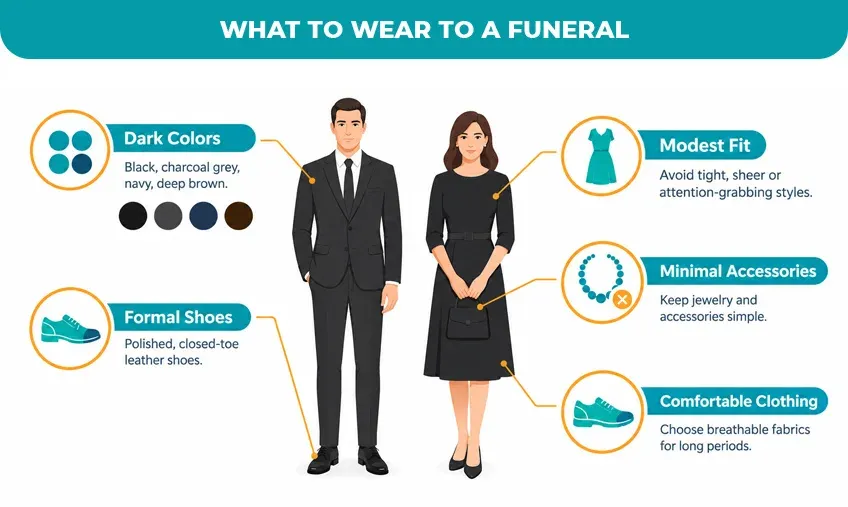
Wear conservative, muted clothing in black, charcoal grey, navy, or deep brown. Men should choose a dark suit or dress pants with a collared shirt and conservative tie. Women should choose a knee-length or midi dress, a pantsuit, or a skirt with modest coverage. Avoid bright colors, casual fabrics like denim, and any clothing that is tight, sheer, or attention-grabbing, unless the family has specifically requested different attire.
Key Takeaways
- Muted, dark colors remain the standard for most Western funerals, though the family’s specific wishes always take priority.
- Modesty and comfort both matter: services often involve extended periods of standing, sitting, and walking between locations.
- Cultural and religious traditions vary widely. Islamic, Jewish, Hindu, Buddhist, and military services each carry their own expectations.
- What you wear to a wake or visitation can be slightly more relaxed than what you wear to the funeral service itself, but the same core principles of modesty and restraint apply.
- When the family requests specific colors or a “celebration of life” theme, follow their instructions over general etiquette norms.
Understanding Traditional Funeral Attire Expectations
The purpose of funeral attire is to show respect for the deceased and support for the grieving family through understated, modest dressing. This principle is the foundation of nearly every Western mourning tradition and is reflected in etiquette frameworks such as the Emily Post Institute’s guidance on funeral and memorial service conduct, which emphasizes conservative, subdued clothing as a way of directing attention toward the family rather than toward the individual attendee.
Color palette. Classic, muted tones are the safest choice at a traditional Western funeral:
- Black
- Charcoal grey
- Navy blue
- Deep brown
- Dark plum or forest green (in smaller accents)
Patterns and cuts. Loud patterns, glossy fabrics, and flashy cuts pull focus away from the service. Simple, structured silhouettes in matte fabrics are the more considerate choice. This is one of the most searched aspects of funeral etiquette, since many attendees specifically want to know what is appropriate to wear to a funeral without seeming underdressed or overdressed.
If the family has requested a specific dress code, such as “wear his favorite color” or “no black, please,” that request always supersedes general convention. Life celebrations, milestone-focused memorials, and services rooted in specific cultural or religious practices frequently call for different colors, which is covered in Section 5.
Appropriate Clothing Options for Men
For men wondering what to wear to a funeral, the standard is straightforward and rooted in traditional business or formal wear.
Suits and Shirts
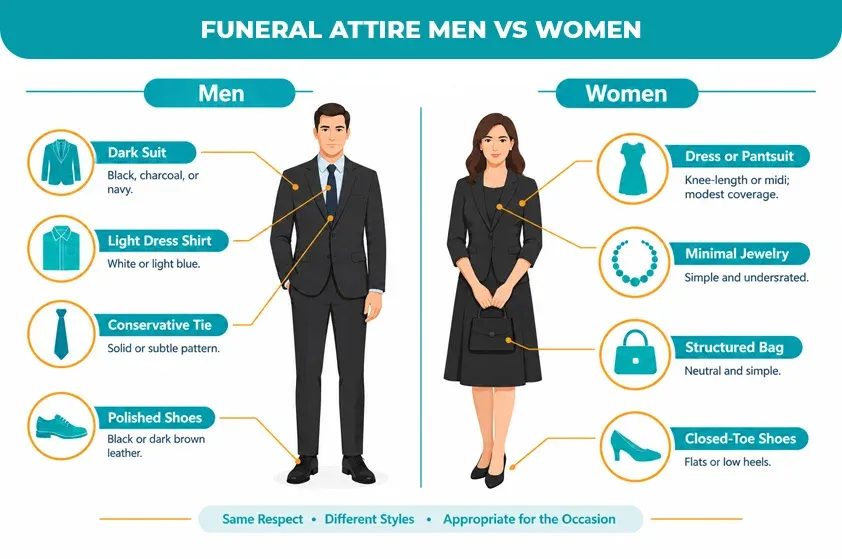
- A dark suit in black, charcoal, or dark navy is the most reliable choice.
- Pair the suit with a clean white or light blue dress shirt.
- If a full suit is not available, dark dress slacks with a blazer and collared shirt are an acceptable alternative.
Ties
A conservative, solid-colored tie, or one with a very subtle, muted pattern, completes the outfit. Bright colors, novelty prints, or bold graphic ties are not appropriate for this setting.
Footwear
Polished black or dark brown leather dress shoes, worn with dark, calf-length socks, are the standard. Sneakers, sandals, and boat shoes are not appropriate, even at more casual celebration-of-life gatherings, unless explicitly welcomed by the family.
Men’s Funeral Attire Checklist
- Confirm the suit is pressed and free of visible wrinkles.
- Choose a solid or subtly patterned tie in a muted tone.
- Skip statement watches, novelty cufflinks, and any loud accessories.
- Wear polished, closed-toe leather dress shoes.
- Keep grooming clean and understated: trimmed facial hair and neatly styled hair.
This guidance applies whether you are searching for what to wear at a funeral for guys, what men wear to a funeral, or what to wear to a funeral as a man attending a formal religious service.
Appropriate Clothing Options for Women
For women asking what to wear to a funeral, the guiding principles are modesty, comfort, and restraint.
Dresses and Skirts
A knee-length or midi-length dress in a conservative color, with modest necklines and sleeves, is a dependable option. If the dress has a low neckline or is sleeveless, pair it with a blazer, cardigan, or shawl for added coverage. A tailored skirt paired with a blouse and blazer works equally well.
Pantsuits
Tailored trousers in black, navy, or dark grey, combined with a conservative blouse, are entirely appropriate. Pantsuits have become a widely accepted option at Western funerals, and this addresses a commonly asked question: yes, it is appropriate for women to wear pants to a funeral, provided the overall look remains conservative and tailored.
Footwear
Closed-toe flats or low-to-medium conservative heels are the most practical choices. Noisy heels can be distracting in a quiet chapel or graveside setting, and overly casual sandals or flip-flops are not appropriate.
Women’s Funeral Attire Checklist
- Choose fabrics that are breathable and comfortable for extended indoor services.
- Layer with a blazer or cardigan if the dress has a low neckline or bare shoulders.
- Opt for closed-toe shoes with a low or medium, stable heel.
- Keep jewelry minimal: small earrings and a simple necklace or watch are sufficient.
- Choose a small, dark clutch rather than a large, casual tote or backpack.
This section applies whether the question is what to wear to a funeral for a woman, what to wear to a funeral for a woman, or what ladies should wear to a funeral more broadly.
Seasonal, Weather, and Venue Considerations
Funeral attire also needs to adapt to the climate and the setting of the service.
Warm Weather
Choose lightweight, breathable fabrics such as fine cotton blends or lightweight wool, while keeping the same level of coverage as you would in any other season. Sleeveless dresses should still be paired with a light cardigan or wrap for the service itself.
Cold Weather
Layer with a heavy, dark wool overcoat, a scarf in a muted tone, and gloves. Outdoor graveside services in cold climates call for practical additions like weather-appropriate closed-toe boots, as long as they remain dark and understated.
Outdoor and Alternative Venues
Modern celebrations of life, outdoor park services, and beach memorials sometimes call for slightly relaxed standards. Even so, the family’s stated wishes should always take priority over general convention. If no specific guidance is given for an outdoor or nontraditional venue, defaulting to conservative, muted attire remains the safer choice.
Visitation and Wake vs. the Funeral Service
Attire for a visitation, viewing, or wake can be slightly more relaxed than attire for the funeral service itself, since these events are often less formally structured and may take place over a longer window of time. However, the same core principles of modest coverage and muted color still apply. A business-casual version of funeral attire, such as dark slacks with a blouse or a conservative sweater, is generally suitable for a visitation, while the funeral or memorial service itself calls for the more formal standard described in Sections 2 and 3.
Cultural, Religious, and Specialty Attire Variations
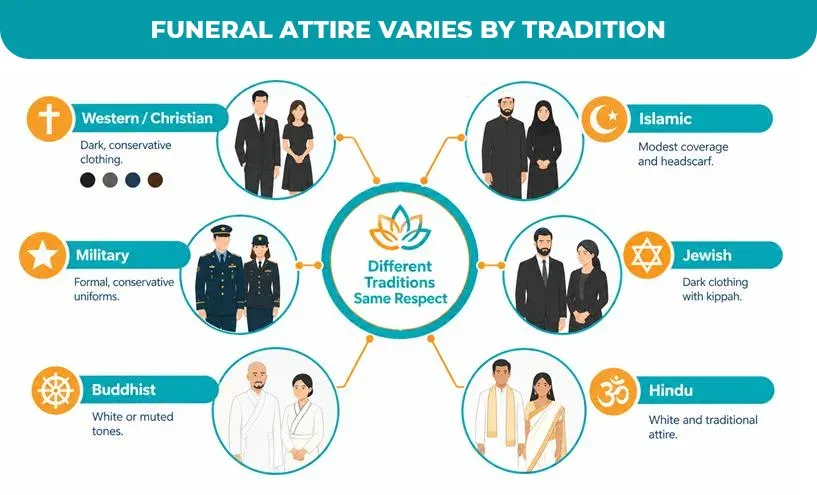
Funeral customs vary significantly across cultural and religious traditions, and dressing appropriately means understanding the specific expectations of the service you are attending.
| Tradition | Color Convention | Key Attire Notes |
| Western/Christian | Black, charcoal, navy, dark brown | Conservative suits, dresses, or pantsuits |
| Islamic | Modest coverage in muted tones | Both men and women cover most skin; women should carry or wear a headscarf |
| Jewish | Dark, conservative colors | Men typically wear a suit and a head covering (kippah); women wear conservative dresses or suits |
| Hindu | White is common | White symbolizes purity and is often worn instead of black |
| Buddhist | White or muted tones | White is frequently worn to symbolize mourning and impermanence |
| Military | Standard formal/conservative attire for civilians | Veterans may wear authorized service ribbons or decorations per official guidelines |
Islamic services. Modesty is a strict expectation for both men and women. Attendees should cover most of their skin, and women should bring a headscarf even if they do not wear one regularly, since covering the head is customary at many Islamic funeral services.
Jewish services. Men typically wear a suit along with a head covering, known as a kippah or yarmulke, which is frequently provided at the entrance of the synagogue or funeral home if the attendee does not have one. Women generally choose conservative dresses or suits consistent with the modesty expectations described in Section 3.
Hindu and Buddhist services. White is commonly worn instead of black, since it is associated with purity, peace, and the cycle of rebirth in many Hindu and Buddhist traditions, rather than mourning in the Western sense. Attendees unfamiliar with the specific family’s customs should ask a close family member or the officiant in advance to confirm expectations.
Military funerals. Civilian attendees should wear standard, conservative funeral attire as described earlier in this guide. Veterans attending in a formal capacity may display authorized service ribbons or medals in accordance with the relevant branch’s dress guidelines.
Because customs differ by family, region, and specific denomination, the safest approach when attending an unfamiliar cultural or religious service is to ask a close friend or family member of the deceased what is expected before you arrive.
What NOT to Wear to a Funeral
Knowing what to wear and what not to wear to a funeral is equally crucial. Unless the family has expressly asked for a different, more relaxed, or more colorful dress code, the following categories are typically seen as improper.
Casual wear. Jeans, graphic T-shirts, athletic sneakers, flip-flops, and shorts read as too informal for the solemnity of a funeral or memorial service.
Flashy or bright attire. Bright neon colors, such as red, orange, or bright yellow, can distract from the tone of the event and are best avoided unless the family has specifically requested festive or colorful attire as part of a celebration of life.
Revealing clothing. Low-cut tops, miniskirts, and overly tight silhouettes work against the modesty expectations that most funeral traditions share, regardless of denomination.
Overly casual accessories. Baseball caps, oversized sunglasses worn indoors, and beach-style sandals do not align with the formality of most services, even outdoor ones.
Three Colors Frequently Advised Against
While no single color is universally banned, three categories are the most commonly cited as inappropriate unless requested by the family:
- Bright neon colors (neon red, orange, or yellow), because they draw visual attention away from the service.
- All-white outfits at a traditional Western funeral, since white is reserved for specific cultural and religious contexts described in Section 5, and wearing it without that context can send an unintended message.
- Busy, high-contrast prints, because they can look festive or celebratory in a setting meant to be quiet and reflective.
Accessories, Grooming, and Children’s Attire
Accessories
Keep jewelry minimal and understated. Small earrings, a simple necklace, or a plain watch are sufficient. A small, dark clutch or handbag is more appropriate than a large, casual tote or backpack, both for the tone of the event and for practicality in a crowded indoor space.
Grooming
Style hair neatly and keep makeup understated. Apply perfume or cologne sparingly, since funeral homes and chapels are often crowded, enclosed spaces where strong scents can be uncomfortable for other attendees, including those who may be sensitive to fragrance.
Children’s Attire
Dress boys in dark slacks with a collared shirt, or a small suit for more formal services. Dress girls in dark, simple dresses or a skirt and blouse combination. Comfort should be prioritized alongside formality, since children may need to sit or stand for extended periods, and overly restrictive clothing can make an already difficult day harder for them to manage.
Conclusion
Dressing appropriately for a funeral is a way of extending empathy to a grieving family during one of the most difficult moments they will face. Conservative colors, modest coverage, and understated accessories allow you to support the people around you without drawing attention away from the purpose of the gathering. When specific family requests or cultural and religious customs differ from general convention, those specific instructions should always take priority.
While thoughtful attire is one way to show care during a time of loss, many families also feel the weight of the financial and logistical decisions that follow a death. Planning for these costs is another way to protect the people you love from added stress during an already difficult time. If you want to explore coverage options designed to ease the financial burden of final expenses for your own family, Premier Services Agency can walk you through tailored options and provide a personalized quote.