


Navigating the labyrinth of healthcare coverage can feel like a high-stakes gamble, especially when balancing predictable monthly premiums against unpredictable medical emergencies. Enter high deductible health insurance (commonly known as an HDHP), a plan structure that has rapidly transformed from a niche alternative into a cornerstone of modern American health benefits. With average deductibles climbing past historical thresholds and millions of consumers weighing lower monthly costs against steeper out-of-pocket exposure, understanding how these policies operate is more critical than ever.
Whether you’re self-employed, shopping on the ACA Marketplace, or evaluating your employer’s open enrollment choices, figuring out whether a high deductible health insurance plan will protect your savings or drain them requires a close look at the math. This guide breaks down everything you need to know, cutting through industry jargon so you can make an informed choice.
The Rise of High Deductible Health Insurance
What Is a High Deductible Health Plan (HDHP) and Why Are They Growing?
An HDHP health plan isn’t defined by marketing language; it’s defined by the IRS. Under federal rules, a plan only qualifies as an HDHP if it meets two thresholds each year: a minimum annual deductible and a maximum limit on out-of-pocket costs. For plan years beginning in 2026, the IRS set these figures in Revenue Procedure 2025-19:
| Coverage Type | Minimum Annual Deductible | Maximum Out-of-Pocket Limit |
| Self-only coverage | $1,700 | $8,500 |
| Family coverage | $3,400 | $17,000 |
A plan must clear the deductible floor and stay under the out-of-pocket ceiling to be considered a true high deductible health insurance plan that’s eligible to be paired with an HSA. One notable 2026 change: bronze-level and catastrophic Marketplace plans are now automatically treated as HDHPs for HSA-eligibility purposes, even if their specific deductible and out-of-pocket figures don’t independently satisfy the standard test, opening HSA access to a much larger pool of Marketplace shoppers.
This shift isn’t happening in a vacuum. Annual employer benefits research from KFF has tracked a steady, multi-year climb in average deductibles across both marketplace and employer-sponsored plans, as employers lean on cost-sharing to offset rising premiums. The result is a benefits landscape where a growing share of workers, particularly at small and mid-sized companies are enrolled in some version of a life insurance plan with a high deductible, whether they explicitly chose it or not.
How HDHPs Work: Deductibles, Copays, and Coinsurance
How High Deductible Health Insurance Functions Day-to-Day
Once you’re enrolled in high-deductible health insurance coverage, the mechanics are straightforward, even if the bills aren’t always painless. Until you hit your deductible, you generally pay 100% of your provider’s negotiated (in-network) rate not the sticker price, but still the full contracted amount. Once you’ve paid that full amount out of pocket, coinsurance typically kicks in, meaning the plan starts sharing costs with you (commonly 70/30, 80/20, or similar splits) until you reach your out-of-pocket maximum.
Preventive Care vs. Everything Else
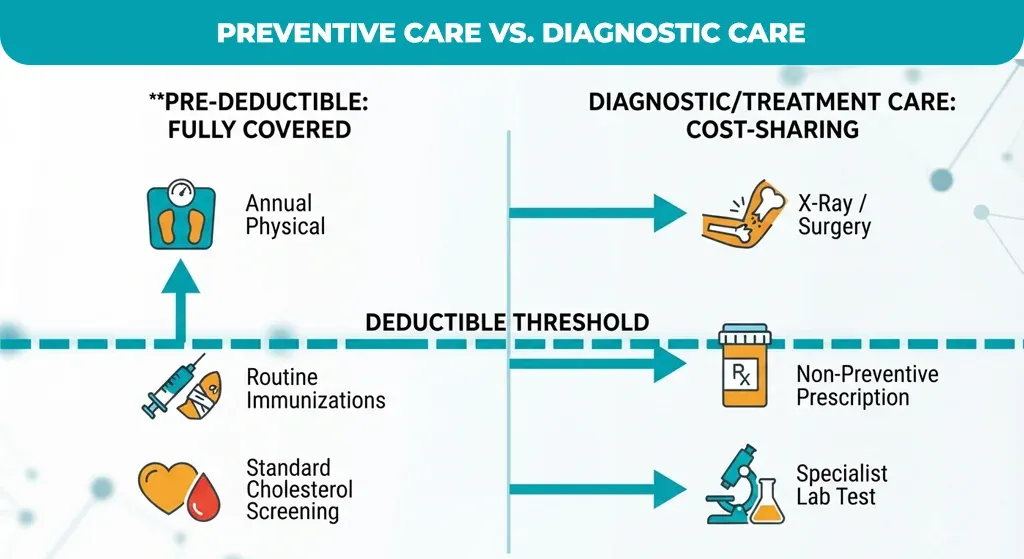
Not all care requires you to pay out of pocket first. Under the Affordable Care Act, HHS guidelines require most private health plans, including HDHPs, to cover a defined list of preventive services: annual physicals, routine immunizations, standard cancer and cholesterol screenings, and similar services at 100% before the deductible is met, with no cost-sharing.
Individual vs. Family: Aggregate vs. Embedded Deductibles
Family coverage adds a wrinkle that trips up a lot of shoppers comparing high vs low deductible health insurance options: the difference between aggregate and embedded deductibles.
- Aggregate family deductible: The full family deductible (e.g., $3,400+) must be met collectively through any combination of family members’ expenses before the plan starts sharing costs for anyone.
- Embedded deductible: Each family member has their own, lower embedded deductible built into the family total (which, for 2026, cannot be set below the $3,400 family minimum). Once one person hits their embedded amount, the plan starts covering that person’s care, even if the family total hasn’t been reached.
This distinction can mean thousands of dollars in difference for a family with one member who needs frequent care and several who rarely see a doctor. Always confirm which structure your plan uses before enrolling.
The Powerhouse Companion: Health Savings Accounts (HSAs) Explained
Maximizing Your HDHP with a Triple-Tax-Advantaged HSA
For most households, high deductible health insurance only makes financial sense when it’s paired with a Health Savings Account. To open and contribute to an HSA, you must be enrolled in a qualifying HDHP and have no other disqualifying coverage, including a general-purpose Flexible Spending Account, most Medicare enrollment, or a non-HDHP plan through a spouse.
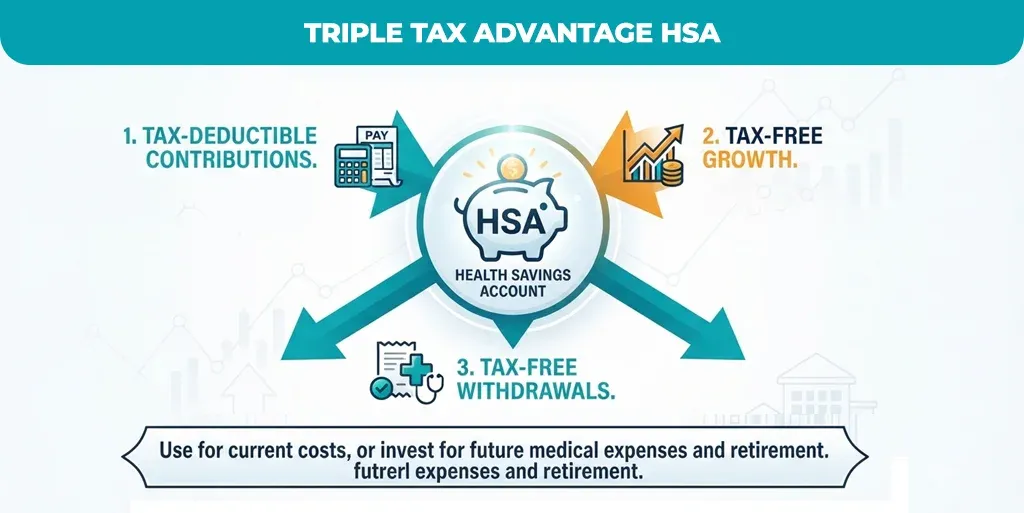
The Triple Tax Advantage. The HSA’s popularity comes down to a benefit structure that’s rare in the U.S. tax code:
- Contributions are tax-deductible (or made pre-tax through payroll), lowering your taxable income for the year.
- Growth is tax-free: interest, dividends, and investment gains inside the account are never taxed as long as they stay in the HSA.
- Withdrawals are tax-free when used for qualified medical expenses, as defined in IRS Publication 502.
Because unused HSA balances roll over indefinitely (unlike a use-it-or-lose-it FSA) and can typically be invested once a minimum cash balance is met, many financial planners treat a fully funded HSA as a secondary retirement account for future medical costs.
2026 HSA Contribution Limits
| Category | 2025 Limit | 2026 Limit |
| Self-only HSA contribution | $4,300 | $4,400 |
| Family HSA contribution | $8,550 | $8,750 |
| Catch-up contribution (age 55+) | $1,000 | $1,000 |
The age-55 catch-up contribution is set by statute rather than inflation-adjusted, so it has remained at $1,000 since it was introduced. Each HSA-eligible spouse age 55 or older must hold a catch-up contribution in their own HSA; it cannot be added to a spouse’s account.
Pros and Cons: Weighing the Financial Risks and Rewards
The True Cost of Care: Advantages and Disadvantages of HDHPs
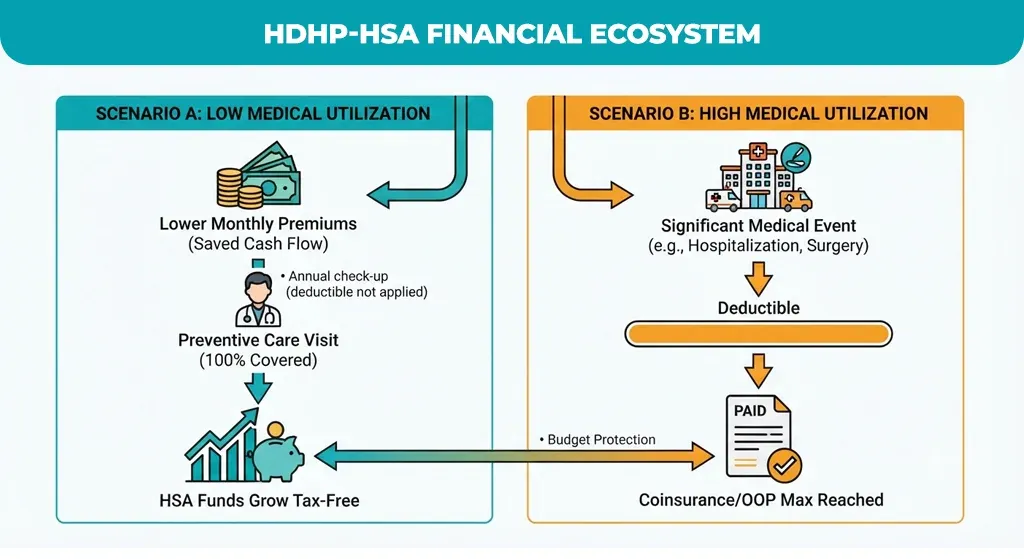
Advantages of high deductible health insurance tend to concentrate around cash flow and long-term savings:
- Lower fixed monthly premiums, which free up cash flow for healthy households or those building an emergency fund.
- Potential employer HSA seed contributions, which effectively lower your real out-of-pocket exposure before you spend a dollar.
- A powerful, triple-tax-advantaged savings and investment vehicle unavailable to those on traditional low-deductible plans.
The cons are just as real, and they concentrate around risk and behavior:
- High financial exposure in the event of a sudden accident, surgery, or new chronic diagnosis; you could owe the full out-of-pocket maximum in a single bad year.
- Research on deferred care shows that patients on high-deductible structures, particularly in lower- and middle-income households, are more likely to delay or skip needed care, including filling prescriptions or following up on abnormal test results, because of upfront cost concerns.
- Unpredictable medical bills can be harder to budget for than a fixed monthly premium, especially without adequate emergency savings.
Conclusion
Deciding whether high deductible health insurance deserves a spot in your financial portfolio ultimately comes down to a calculated balancing act between guaranteed monthly savings and variable medical risk. By thoroughly evaluating your historical healthcare utilization, factoring in the unmatched wealth-building muscle of a triple-tax-advantaged Health Savings Account, and modeling your true annual cost of care, you can confidently determine whether an HDHP will protect your nest egg or compromise it.
Do not let open enrollment catch you off guard this season. Take control of your financial future today by auditing your past two years of medical expenses, projecting your upcoming health needs, and choosing the strategic coverage that transforms healthcare costs from a guessing game into a predictable, manageable asset.