

Imagine your final resting place not as a cold stone marker in a manicured cemetery, but as a living, flourishing tree that breathes life back into the earth. The revolutionary tree pod burial has captured the global imagination as the ultimate eco-friendly afterlife option, transforming grief into a breathtaking, sustainable legacy.
However, navigating the reality behind the viral concept art can feel overwhelming. This comprehensive guide cuts through the confusion, revealing what is commercially available today, how these biodegradable systems work, and the exact costs and legal requirements you need to know. Read on to discover how a simple tree pod burial can turn a final goodbye into a profound act of environmental renewal.
What Is a Tree Pod Burial?
A tree pod burial is a form of natural burial in which cremated remains or, in a still-developing concept, an unembalmed body are placed in a biodegradable container together with a tree seed or sapling. As the organic pod breaks down, it’s designed to release nutrients into the soil that help nourish the tree above it, turning a burial site into a living memorial rather than a static one.
The idea traces back to Capsula Mundi, an Italian design project that popularized the image of an egg-shaped, biodegradable pod holding a curled body beneath a newly planted tree. That image went viral and shaped how most people picture this option. But there’s an important distinction worth understanding upfront:
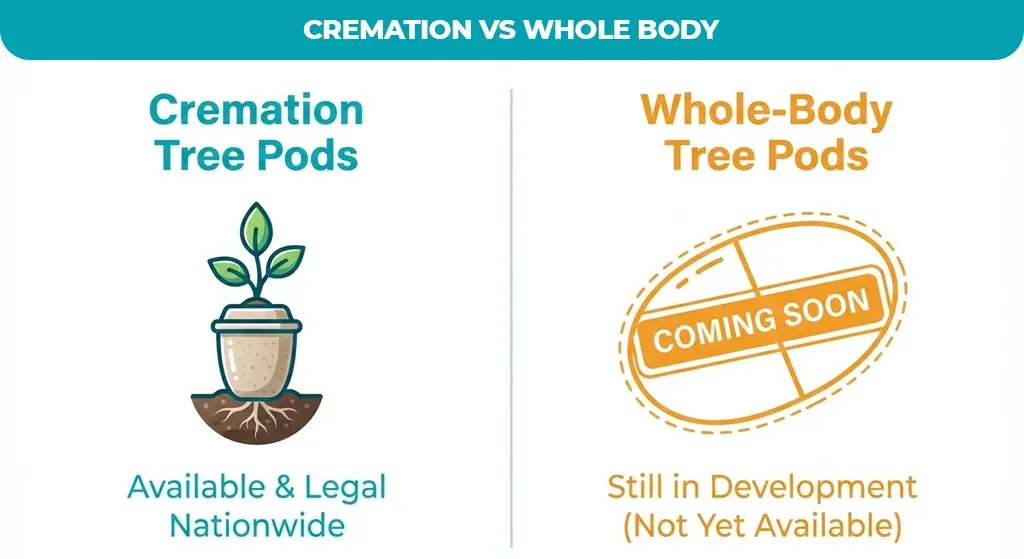
- Whole-body tree pods, the full-size, Capsula Mundi–style concept, remain in development. The company itself describes the body pod as still in a start-up phase, not yet available for purchase anywhere, including the US.
- Cremation tree pods and biodegradable urns smaller pods designed to hold ashes rather than a body are real, commercially available, and legal in many states today. Companies like Capsula Mundi, Bios Urn, and The Living Urn all sell this version.
So when people search for “tree pod burial,” what’s actually available to buy and use right now is the cremation version. The whole-body pod is the idea that captured everyone’s imagination; the ashes-based burial pod tree is the option you can actually choose.
This matters for context. Traditional burial has a real environmental cost: embalming relies on chemical fluids, and standard vaults use significant amounts of concrete and steel. Cremation, while lighter on materials, still carries a notable carbon footprint from the energy used in the process itself. A biodegradable tree pod burial built around a compostable urn sidesteps the material-heavy parts of a traditional funeral and redirects cremated remains toward something that grows.
How Tree Pod Burials Work: The Step-by-Step Process
Here’s what actually happens with today’s commercially available tree burial pods, from planning through planting.
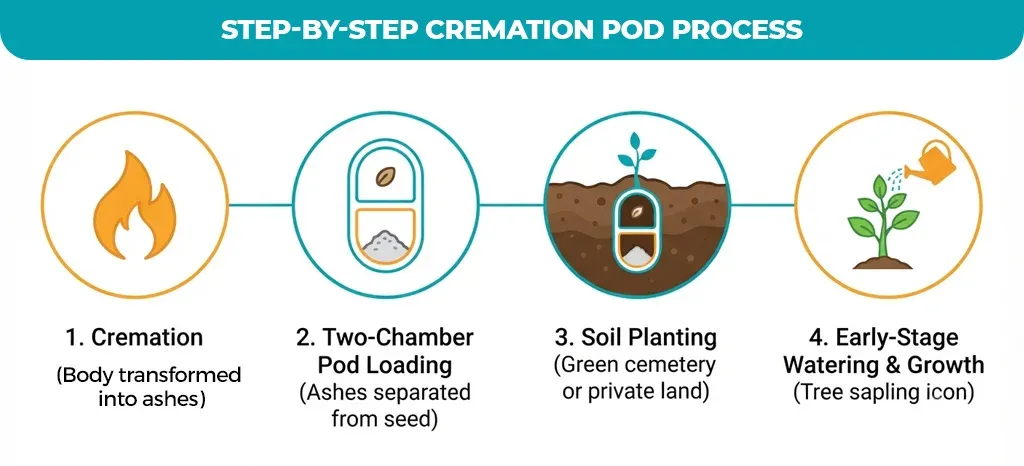
Cremation. Since whole-body pods aren’t yet market-ready, remains are cremated first, following the same process as a standard cremation.
Select the pod. Most cremation-based tree pods use a two-chamber design: one chamber for the ashes, one for the seed or seedling, kept separate for a period of time. This separation matters because cremated remains are highly alkaline and can damage tender roots if they touch the seed directly and too soon.
Choose a tree species. The tree should suit the local climate, soil pH, and available root space. Native species are generally recommended because they’re adapted to local rainfall and temperature patterns and require less intervention to thrive.
Secure a location. The pod is planted in soil at a green cemetery, a memorial forest, a family property, or another location where the plan is legally permitted (see the legal section below).
Ongoing care. Unlike a headstone, a tree pod burial needs early-stage watering and monitoring, especially in the sapling’s first one to two years, before root establishment reduces the maintenance burden.
Environmental Benefits of Choosing a Tree Pod
Compared with a traditional casket-and-vault burial, a tree pod burial offers several genuine ecological advantages:
- No embalming fluid. Traditional embalming relies on formaldehyde-based chemicals that can leach into soil over time; green and tree pod burials skip this step entirely.
- No concrete or steel vault. Traditional burial vaults consume significant raw materials per interment; biodegradable pods use compostable materials instead.
- Living memorial instead of a static marker. A tree contributes to local carbon sequestration and habitat over its lifetime, rather than occupying land indefinitely as a maintained, chemically treated lawn plot.
- Support for reforestation and conservation land. Many green cemeteries and memorial forests use burial fees to fund land conservation, effectively turning burial plots into protected habitat rather than developable land.
The core trade-off to understand: tree pod burial is meaningfully greener than a traditional funeral, but it doesn’t erase cremation’s own carbon footprint. If minimizing environmental impact is the priority, pairing a tree pod with a lower-emission cremation provider or considering natural organic reduction (“human composting”) where legally available can extend the same values further.
Are Tree Pod Burials Legal? Regulations and Where to Go
Legality depends entirely on which version you mean.
Cremation tree pods (ashes-based): These are legal across the United States. Cremated remains are generally not subject to the same regulations as whole-body burial, and most states allow scattering or burial of ashes on private property with permission, or at licensed cemeteries and memorial forests. Some states and municipalities have local rules about scattering on public land or waterways, so it’s worth checking with the specific cemetery, park authority, or state health department before proceeding.
Whole-body tree pods: As of 2026, this version is not commercially available or legally approved anywhere, including every US state. Whole-body burial in the US is still governed by existing green burial and natural burial regulations, which vary by state but generally require:
- Burial at a licensed cemetery (green, hybrid, or conventional)
- An unembalmed body wrapped in a biodegradable shroud or placed in a biodegradable casket
- Compliance with state-specific depth and setback requirements
Therefore, a family would normally choose a green burial in a certified natural cemetery if they were interested in the spirit of a tree pod burial for a whole body tree planted at or near the gravesite using existing legal frameworks rather than a literal Capsula Mundi-style pod, which isn’t yet on the market anywhere.
Tree Pod Burial Cost: Is It More Affordable?
Cost varies significantly depending on which version you’re comparing and what’s included.
| Option | Typical Cost Range | What’s Included |
|---|---|---|
| Cremation-based tree burial pod/urn | $100 – $500 | Biodegradable pod or urn only |
| Basic cremation (direct, no service) | $1,095 – $2,500 | Cremation only, no viewing |
| Full cremation with viewing/service | ~$6,280 – $6,940 | Service, viewing, cremation |
| Green/natural burial (whole body) | $1,500 – $5,000+ | Plot, shroud/biodegradable casket, service |
| Traditional funeral with burial | $8,300 – $9,995+ | Casket, embalming, service, vault |
| Sapling or tree for planting | $50 – $200+ | Species-dependent |
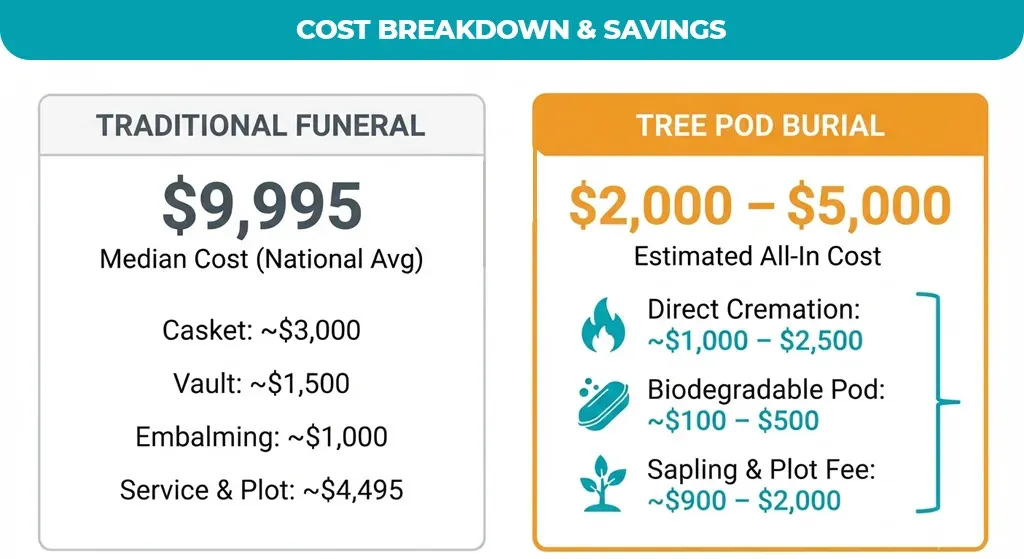
A realistic all-in tree pod burial cost is direct cremation plus a biodegradable pod plus a tree and plot fee, typically lands somewhere between $2,000 and $5,000, according to industry cost breakdowns from providers currently selling cremation-based pods. That’s a substantial savings compared to the national median for a traditional funeral with burial and vault, which the National Funeral Directors Association places at roughly $9,995 as of its most recent survey data (adjusted for 2026 pricing).
Where the savings come from is straightforward: a tree pod burial eliminates the biggest line items in a traditional funeral a burial-grade casket, embalming, and a concrete vault while replacing a cemetery headstone with a one-time sapling cost and, often, a lower ongoing maintenance fee than a conventional plot.
Conclusion
Tree pod burial offers a profoundly meaningful, eco-friendly alternative to traditional end-of-life options, transforming a final resting place into a living, flourishing legacy. By turning cremation ashes into a sustainable forest memorial, this innovative practice honors both your loved ones and the earth, ensuring that grief blossoms into enduring growth.
Embracing a tree pod burial is a powerful step toward a greener, more conscious future. Whether you are pre-planning your own legacy or seeking solace after loss, choosing this sustainable path allows you to leave the planet healthier than you found it.