


If a business owner dies, the company can lose its leader, its biggest relationships, and sometimes its ability to repay loans, all at once. Surviving partners may also end up in business with the deceased owner’s heirs.Life insurance can fund the solutions to each of those problems.
Quick answer: Business owners use life insurance to protect the company (key person coverage), fund partner buyouts (buy-sell agreements), secure loans, and reward key employees. Premiums are generally not tax-deductible when the business is a beneficiary, but death benefits are generally income-tax-free if IRS rules are followed.
What Is Business Life Insurance & Why Do Owners Need It?
Life insurance for business owners is coverage structured to protect the business, not just the owner’s family. It can replace a key person’s value, fund the purchase of a deceased owner’s share, repay business debts, and attract or retain key employees. The policy itself is ordinary life insurance; what makes it “business” insurance is who owns it, who pays, and who receives the payout.
The entrepreneur’s risk matrix
Business owners usually need two layers of protection: personal coverage for their family and business coverage for the company. Mixing the two can leave gaps.
| Risk | Who’s affected | Typical solution |
| Family loses your income | Spouse and children | Personal term or whole life |
| Company loses its key leader or rainmaker | Business, employees, lenders | Key person insurance |
| Partners must buy out your heirs | Co-owners and your estate | Buy-sell agreement funded by life insurance |
| Business loan comes due | Lender, guarantors | Term life assigned as collateral |
| Key employees leave | Business | Executive bonus or split-dollar plan |
| Estate taxes on a valuable business | Heirs | Permanent life insurance for liquidity |
Do small businesses offer life insurance?
Many do, but far fewer than large employers. In March 2026, 40% of private industry workers at establishments with fewer than 50 workers had access to employer life insurance, compared with 86% at establishments with 500 or more workers, according to the U.S. Bureau of Labor Statistics. Across all private industry, 59% had access.
Small businesses typically offer:
• Group term life insurance for employees, often a flat amount or a multiple of salary.
• Key person and buy-sell policies for owners and essential executives.
• Executive bonus plans for a few key employees.
See our guide to group life insurance for employee plans.
Core Business Life Insurance Strategies: Buy-Sell, Key Person & Executive Benefits
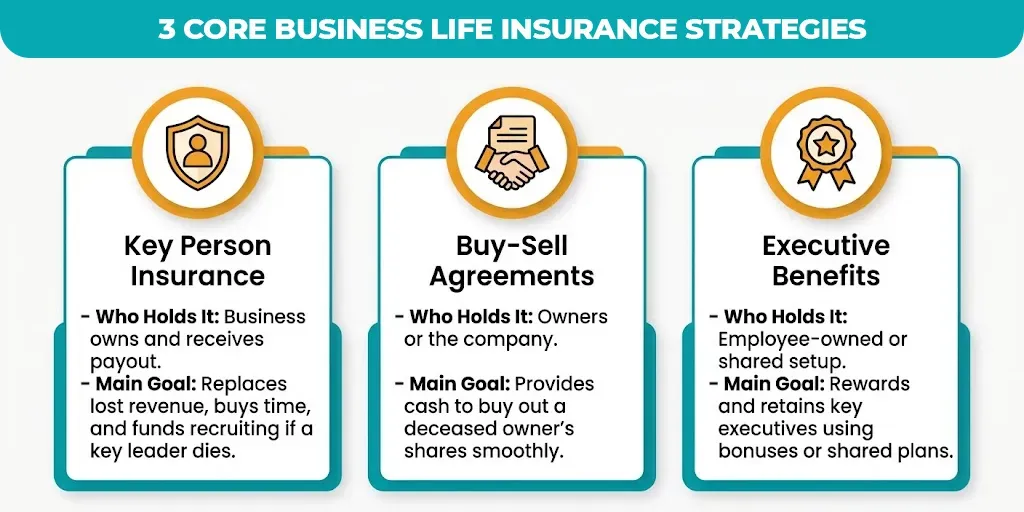
The three core life insurance strategies for business owners are key person insurance, buy-sell agreement funding, and executive benefit plans. Each one sets up ownership, premium payments, and beneficiaries differently.
Strategy 1: Key person insurance
Key person insurance is a policy the business owns on an owner or essential employee, with the business as beneficiary. If that person dies, the payout helps the company replace lost revenue, recruit a replacement, reassure lenders, and keep operating.
How to size it:
• Estimate the revenue or profit the person drives.
• Add the cost to recruit and train a replacement.
• Add any business debts the person personally guarantees.
Note: Because the business owns the policy and is the beneficiary, IRC § 101(j) applies to employer-owned life insurance. The employee must receive written notice and give written consent before the policy is issued, or the tax-free death benefit can be limited to the premiums paid.
Strategy 2: Buy-sell agreements
A buy-sell agreement is a contract that requires the surviving owners or the company to buy a deceased owner’s share at a set price, and life insurance provides the cash to do it. The heirs receive fair value, and the surviving owners keep control.
Cross-purchase: each owner buys a policy on the other owners. When one dies, the survivors use the payout to buy the deceased owner’s share directly.
Entity-purchase (stock redemption): the business owns a policy on each owner and buys back the deceased owner’s share.
| Feature | Cross-purchase | Entity-purchase (redemption) |
| Who owns the policies | The individual owners | The business |
| Number of policies | Grows quickly with more owners | One per owner |
| Survivors’ tax basis | Increases by the purchase price | Generally doesn’t increase the same way |
| Estate tax valuation risk | Lower after Connelly | Insurance proceeds can raise the company’s value |
| Best for | 2–3 owners | Larger ownership groups (with careful valuation planning) |
The Connelly decision. On June 6, 2024, the U.S. Supreme Court unanimously ruled in Connelly v. United States that a company’s obligation to redeem a deceased owner’s shares did not offset the life insurance proceeds the company received to fund it. The proceeds increased the company’s value for estate tax purposes. Many advisors now review redemption-style agreements, and some recommend cross-purchase structures.
Strategy 3: Executive bonus plans and split-dollar arrangements
Executive bonus (Section 162) plan: the business pays a bonus to a key employee, who uses it to pay premiums on a policy they own. The business can generally deduct the bonus as compensation if it’s reasonable, and the employee includes it in taxable income. The employee owns the policy and its cash value.
Split-dollar arrangement: the business and employee share a policy’s costs and benefits under a written agreement. IRS regulations treat these arrangements either as an economic-benefit arrangement or a loan, which affects how each side is taxed.
These plans help retain key talent without the rules of qualified retirement plans.
Coverage note for life coaches and solopreneurs
A business owners policy (BOP) bundles property and liability insurance; it doesn’t include life insurance. Life coaches, consultants, and freelancers usually need a personal term or permanent policy instead, sometimes paired with disability insurance to protect income while alive.
Business life insurance strategies matrix
| Strategy | Primary objective | Who pays premiums | Beneficiary | Business impact |
| Key person | Protect revenue and stability | Business | Business | Cash to survive the loss |
| Cross-purchase buy-sell | Fund owner buyouts | Each owner | Co-owners | Smooth ownership transfer |
| Entity-purchase buy-sell | Fund share redemption | Business | Business | Company buys back shares |
| Executive bonus (§ 162) | Retain key employees | Business (via bonus) | Employee’s family | Deductible compensation |
| Split-dollar | Share policy costs and benefits | Shared | Split per agreement | Retention and benefit tool |
| Loan collateral | Protect lender | Owner or business | Lender (collateral assignment) | Meets loan requirements |
| Group term life | Employee benefit | Business | Employees’ families | Recruiting and retention |
Term vs. Whole vs. Universal Life Insurance for Business Owners
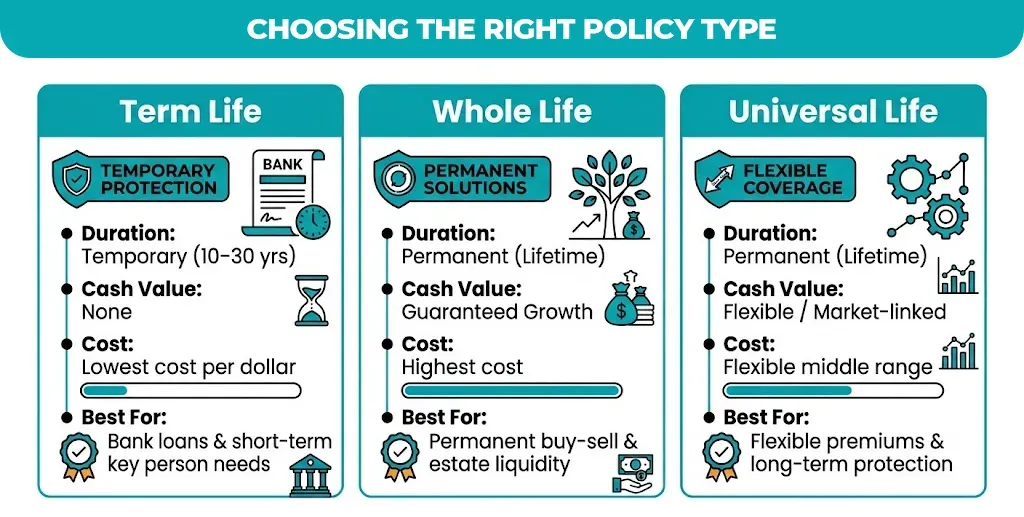
Term life is usually best for time-limited business needs like loans and early-stage buy-sell funding. Whole and universal life fit permanent needs, such as estate liquidity, long-term buy-sell funding, and cash value strategies.
Term life insurance
Term life covers a set period, usually 10 to 30 years, at the lowest cost. It’s a strong fit for:
• SBA and bank loans: lenders may require life insurance assigned as collateral for the loan term.
• Start-up and growth phases: maximum coverage for the lowest premium.
• Buy-sell agreements expected to end when an owner retires.
• Key person coverage for a defined period.
Read more about term life insurance.
Whole life insurance
Whole life provides lifetime coverage, fixed premiums, and guaranteed cash value growth. For business owners, it can:
• Fund buy-sell agreements that last until death, not just retirement.
• Provide estate liquidity so heirs don’t have to sell the business.
• Build cash value the owner can borrow against.
The trade-off is cost: whole life premiums are many times higher than term for the same coverage. See whole life insurance.
Universal life insurance
Universal life offers lifetime coverage with flexible premiums and adjustable death benefits. Pros and cons for business owners:
• Pros: flexibility when cash flow varies; some versions (guaranteed universal life) offer lifetime coverage at lower cost than whole life.
• Cons: cash value can underperform if interest rates or index credits are low, and underfunded policies can lapse. Indexed and variable versions add complexity.
Compare universal life and indexed universal life.
Term vs. whole vs. universal life for business owners
| Policy type | Premium structure | Cash value | Best business use | Cost efficiency |
| Term | Level for the term | None | Loans, key person, temporary buy-sell | Highest coverage per dollar |
| Whole life | Fixed for life | Guaranteed growth; dividends possible | Permanent buy-sell, estate liquidity | Lowest coverage per dollar |
| Guaranteed universal life | Flexible, set to guarantee coverage | Minimal | Lifetime coverage at lower cost | Middle |
| Indexed or variable universal life | Flexible | Market-linked growth | Supplemental cash value strategies | Varies; higher complexity |
Tax Rules, Deductibility & Underwriting Disqualifications
Life insurance premiums are generally not tax-deductible when the business is directly or indirectly a beneficiary, but the death benefit is generally income-tax-free. The exceptions, such as group term coverage and executive bonus plans, depend on how the policy is structured.
Is life insurance tax-deductible for small businesses?
Usually not for key person or buy-sell policies. IRC § 264(a)(1) denies a deduction for life insurance premiums if the taxpayer is directly or indirectly a beneficiary under the policy.
| Arrangement | Premiums deductible? | Death benefit taxable? |
| Key person (business owns and is beneficiary) | No (§ 264) | Generally no, if § 101(j) notice and consent are met |
| Entity-purchase buy-sell | No | Generally no; may raise company value for estate tax (Connelly) |
| Cross-purchase buy-sell (owners pay) | No (personal expense) | Generally no |
| Executive bonus (§ 162) | Bonus generally deductible as reasonable compensation | Generally no to the employee’s beneficiaries |
| Group term life for employees | Generally deductible as an employee benefit | Generally no |
| Personal policy paid by the owner | No | Generally no |
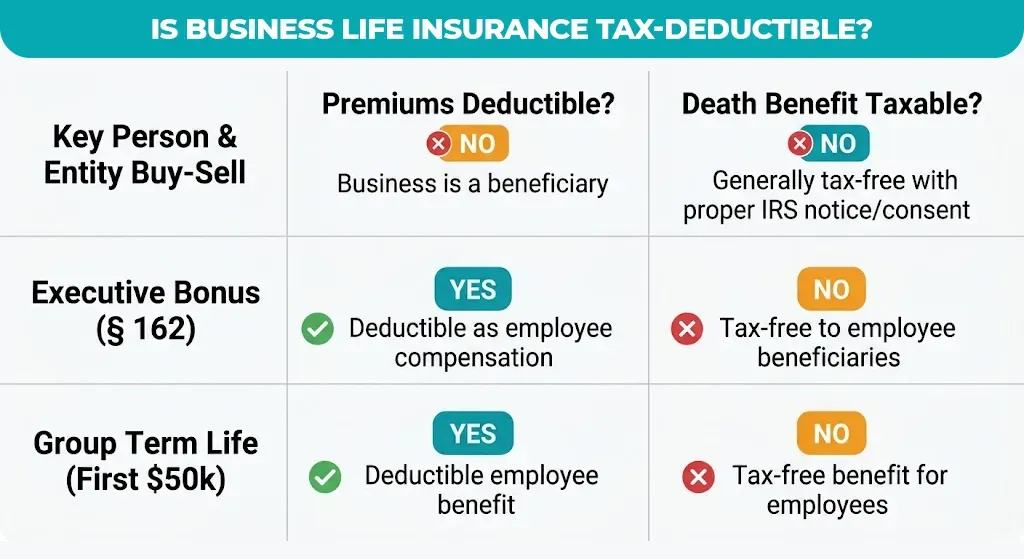
Tax-free death benefits. Under IRC § 101(a), life insurance death benefits are generally excluded from gross income. For employer-owned policies, § 101(j) requires written notice to the employee and written consent before the policy is issued.
Group term life and the $50,000 rule. Under IRC § 79, the first $50,000 of employer-provided group term life coverage is excluded from an employee’s income. The cost of coverage above $50,000 is taxable income to the employee. Owners of sole proprietorships and partnerships, and more-than-2% S corporation shareholders, generally aren’t treated as employees for this benefit, so confirm with your tax advisor.
Note: Business life insurance tax rules are technical. Have a CPA or tax attorney review any key person, buy-sell, or executive benefit plan before you set it up.
What disqualifies you from life insurance?
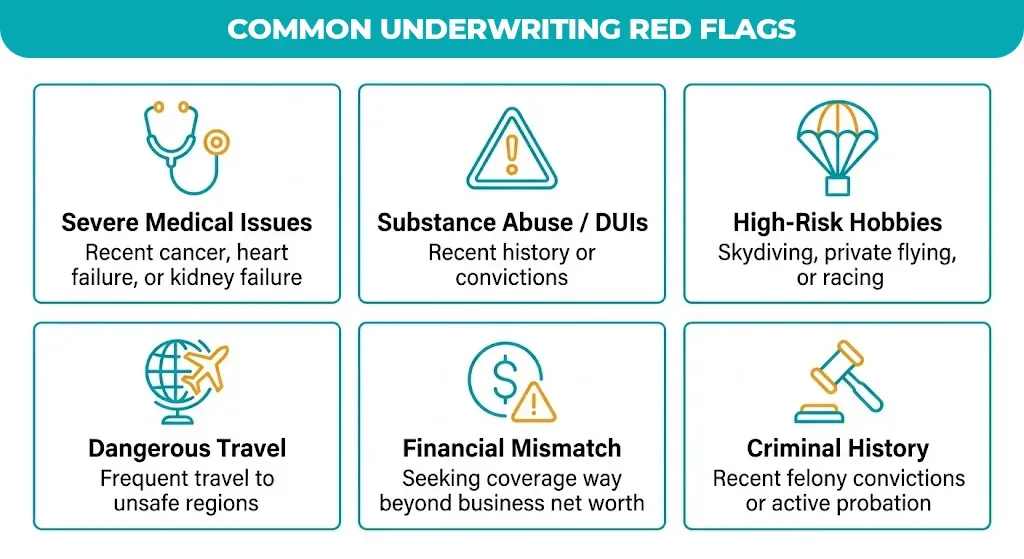
Few things permanently disqualify you, but some conditions can lead to a decline, a postponement, or much higher premiums with traditional underwriting. Common red flags:
• Serious or recent medical conditions: recent cancer treatment, heart failure, kidney failure on dialysis, or a terminal diagnosis.
• Recent substance abuse or DUI convictions.
• High-risk hobbies: skydiving, private aviation, or motor racing, often rated or excluded.
• Dangerous travel to high-risk countries.
• Financial issues: coverage far above what your income or net worth justifies, or recent bankruptcy, can limit how much an insurer will issue.
• Criminal history: recent felony convictions or current probation.
If you’re declined, simplified-issue or guaranteed-issue policies may still be available, usually for smaller amounts.
How much does a $1,000,000 life insurance policy cost per month?
A healthy business owner can usually get $1,000,000 of 20-year term coverage for about $23 to $48 a month at ages 30 to 40, rising to $263 to $379 a month at age 60. Whole life costs many times more.
| Age | 20-year term (female) | 20-year term (male) | Whole life (female) | Whole life (male) |
| 30 | $23 | $29 | n/a | n/a |
| 40 | $40 | $48 | $985 | $1,160 |
| 50 | $95 | $128 | $1,531 | $1,783 |
| 60 | $263 | $379 | $2,613 | $2,994 |
Source: Choice Mutual published sample monthly rates, preferred non-tobacco, valid March 9, 2026 (term coverage amount inferred from table order); Choice Mutual whole life chart ($1,000,000 table). Your rate depends on health, tobacco use, and carrier.