


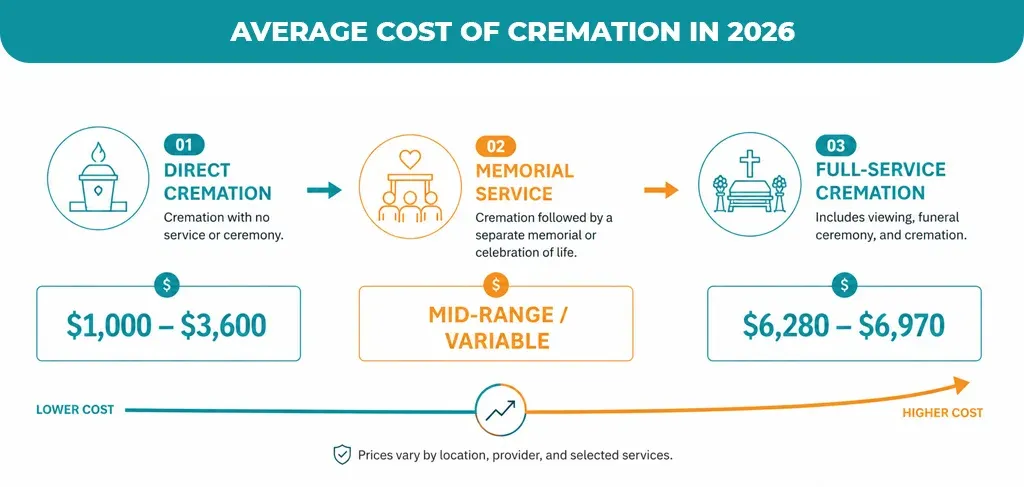
Losing someone you love is hard enough without having to decode confusing pricing at a funeral home. If you’re searching for the average cost of cremation, you’re probably trying to plan ahead, compare quotes, or simply understand whether the number you were quoted is fair. The short answer: a direct cremation with no service typically runs $1,000 to $3,600, while a full-service cremation with viewing and a funeral ceremony averages closer to $6,280 to $6,970 nationally. Where you land inside that range depends on the type of service you choose, where you live, and which optional add-ons you select.
This guide breaks down what the average cost of a cremation is in plain terms, walks through every cost driver, compares 2026 pricing across states, and gives you a practical framework for shopping providers without feeling pressured. Whether you’re asking about the average cost of cremation and funeral together, or you specifically want the average cost of cremation without service, you’ll find the numbers and the reasoning behind them below.
Understanding Cremation: Types & What They Cost
Not all cremations are priced the same, because “cremation” describes several very different service levels. Before you can evaluate any quote, it helps to know exactly what you’re comparing.
Direct Cremation
- The body is transported into the provider’s care, all required paperwork and permits are filed, the cremation is performed, and the ashes are returned, typically in a basic container.
- No embalming, viewing, or funeral ceremony is included.
- This is the most budget-friendly path, and the one most people mean when they ask about the average cost of cremation without service.
- National range: roughly $1,000 to $3,600, with many providers charging closer to $2,000 to $3,000 for a mid-range package.
Cremation with Memorial Service
- The cremation happens first (usually as a direct cremation), and the family holds a separate memorial or celebration of life afterward, with or without the urn present.
- Because the memorial is scheduled independently of the cremation itself, families have more flexibility on timing, venue, and budget.
- Costs vary widely depending on venue, catering, and whether a celebrant is hired, but this route generally stays well below full traditional funeral pricing.
Traditional Cremation (Full-Service)
- Includes embalming, a formal viewing or visitation, a staffed funeral ceremony with a casket, and cremation instead of burial.
- This mirrors a traditional funeral in structure and cost, since most of the same services and staff time are involved.
- According to the National Funeral Directors Association (NFDA), the most recent reported median for a funeral with viewing and cremation is $6,280, with more recent estimates adjusted for inflation trending closer to $6,940 to $6,970.
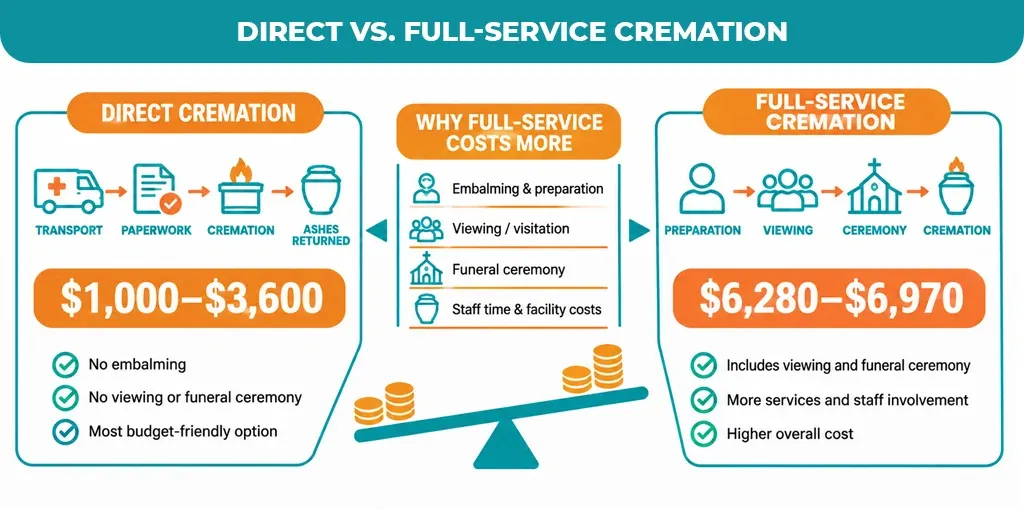
For perspective, the average cost of cremation and funeral combined tends to fall well below the average cost of a traditional burial funeral, which the NFDA places at roughly $7,848 before cemetery costs, and closer to $9,995 to $11,040 once a vault and burial plot are included. That gap is the main reason cremation now accounts for the majority of dispositions in the United States, with national cremation rates above 63% as of the most recent NFDA reporting.
What Affects the Cost of Cremation?
Even within “direct cremation,” prices swing by thousands of dollars depending on a handful of line items. Understanding each one helps you spot where you can save and where a price that looks unusually low might be missing something.
- Provider (Basic Services) Fee. This is the non-declinable fee every funeral home or cremation provider charges to cover overhead: staff time, facility costs, and coordination of the arrangements. It’s built into every package regardless of what else you choose.
- Transportation & Permits. Providers charge for transferring the deceased into their care, and for filing the state-required permits and death certificates that legally authorize a cremation. Mileage fees can apply if the transfer covers a long distance.
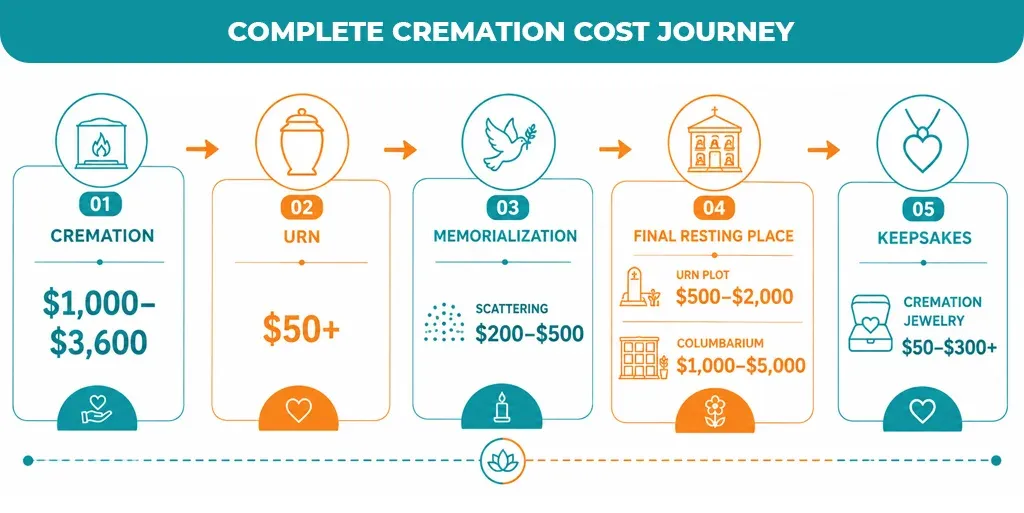
- Container and Urn Selection. State law requires a rigid, combustible alternative container for the cremation itself; this is usually the cheapest option, often costing well under $200. A decorative or permanent urn is a separate, optional purchase, and prices range from under $50 for a simple option to several hundred dollars for a custom or keepsake piece.
- Additional Services. Celebrant or clergy fees, obituary notices, extra certified copies of the death certificate, and keepsake items such as cremation jewelry all add to the total. None of these are required by law, so you can decline any of them.
Pricing Transparency Under the FTC Funeral Rule
The Federal Trade Commission’s Funeral Rule requires every funeral home and cremation provider in the country to give you an itemized General Price List (GPL) on request, and to let you buy only the goods and services you actually want; you cannot be forced to purchase a package that includes items you decline. Providers are also barred from charging a “casket handling fee” if you bring in a container purchased elsewhere.
Average Cremation Costs by State 2026
Cremation prices vary considerably by region, driven by local cost of living, funeral home density, state permit fees, and how much competition exists from direct cremation providers. Areas with a higher cost of living and less market competition, parts of the Northeast and Upper Midwest, for example, tend to sit at the higher end. States with more direct-to-consumer cremation providers and a lower cost of living tend to be more affordable.
Based on aggregated 2026 provider pricing data, states such as Connecticut, North Dakota, and Iowa report some of the highest average direct cremation costs, while states like Oregon, Nevada, and Arizona tend to report some of the lowest.
| State | Average Direct Cremation Cost | Average Full-Service Cremation Cost |
| California | $2,200 – $3,200 | $6,500 – $8,500 |
| Texas | $1,800 – $2,800 | $6,000 – $7,800 |
| Florida | $1,700 – $2,700 | $5,800 – $7,500 |
| New York | $2,400 – $3,400 | $7,200 – $9,200 |
| North Carolina | $1,600 – $2,600 | $5,800 – $7,400 |
| Connecticut | $2,900 – $3,600 | $7,500 – $9,500 |
| Ohio | $1,700 – $2,700 | $5,900 – $7,600 |
| Arizona | $1,300 – $2,200 | $5,200 – $6,900 |
| Oregon | $1,300 – $2,200 | $5,300 – $7,000 |
| Illinois | $1,900 – $2,900 | $6,200 – $8,000 |
How to Compare Cremation Prices: A Consumer Guide
Comparing cremation providers is less about finding the single cheapest headline price and more about making sure you’re comparing the same list of services. Here’s how to do it properly.
Request the General Price List (GPL)
Under the FTC Funeral Rule, you have the legal right to request an itemized GPL from any funeral home or cremation provider by phone, in person, or often on the provider’s website. You do not need to visit in person or disclose that a death has occurred to request pricing.
Compare Direct Cremation Providers vs. Traditional Funeral Homes
Dedicated direct cremation companies typically operate without a full-service showroom, viewing rooms, or embalming staff, which lets them offer flat, lower rates, often 50% to 90% below a traditional funeral home’s comparable package. Full-service funeral homes can still be the right choice if you want viewing, ceremony space, and staff support all under one roof, but expect to pay for that infrastructure.
Watch for Hidden or Add-On Fees
Before signing anything, ask specifically about:
- Storage or refrigeration fees if the cremation isn’t performed immediately
- Mileage charges beyond a certain radius
- Extra certified death certificate copies (often needed for banks, insurance, and Social Security)
- “Processing” or administrative fees not itemized on the GPL
- Urn markups, since a provider’s in-house urns are often priced well above what the same item costs from an independent retailer
The Consumer Financial Protection Bureau recommends getting every quote in writing and comparing at least two to three providers before committing, since prices for the same package can differ by thousands of dollars even within the same city.
Memorialization After Cremation: Options & Costs
Once the cremation itself is complete, families have several ways to memorialize their loved one, and the price range is just as wide as the cremation options themselves.
Scattering Services
Scattering ashes at sea through a licensed provider typically costs $200 to $500, while scattering in a national park or designated memorial garden is often free with a permit, though some managed gardens charge a nominal placement fee.
Cemetery & Columbarium Options
- A cemetery plot sized for an urn is generally less expensive than a full burial plot, often running $500 to $2,000 depending on location.
- A columbarium niche, a small wall or building compartment designed to hold an urn, typically costs $1,000 to $5,000, plus a one-time opening and closing fee in the range of $200 to $600.
- Green burial grounds, which allow biodegradable urns to be placed directly in natural settings, often price comparably to a standard urn plot.
Keepsakes & Cremation Jewelry
Cremation jewelry, including pendants that hold a small portion of ashes or fingerprint-engraved charms, generally ranges from $50 for simple pieces to $300 or more for custom metalwork. Blown-glass memorial art, which incorporates a small amount of ash into the glass itself, typically runs $150 to $400 per piece.
Memorial & Life Celebration Services
A growing number of families are choosing to separate the cremation itself from the memorial gathering, which opens up far more flexibility both in timing and in cost.
Planning a Celebration of Life
Unlike a traditional funeral home service, a celebration of life can be held virtually anywhere: a backyard, a favorite restaurant, a park, or a rented event space. This format tends to feel less clinical and more personal, and it lets families schedule the gathering weeks or months after the cremation if that works better logistically.
What Drives the Cost
- Venue rental, if not held at a home or free public space
- Catering or refreshments
- A celebrant or officiant to guide the service, typically $150 to $600
- Printed programs, photo displays, or guest books
DIY vs. Full-Service Coordination
Planning the gathering yourself choosing the venue, ordering catering directly, and writing the program can keep costs to a few hundred dollars beyond the venue itself. Hiring a funeral home or independent event coordinator to manage logistics adds a service fee but removes the burden of planning during an already difficult time. For many families, a middle-ground approach works well: handle the personal touches yourself, and pay a coordinator only for the pieces that require more logistics, like catering and rentals.
Conclusion & Next Steps
The average cost of cremation ranges from roughly $1,000 for the simplest direct cremation to nearly $7,000 for a full-service cremation with viewing and ceremony, and where you land depends entirely on the choices you make along the way. The most important step you can take is requesting an itemized price list from more than one provider before committing to anything, so you know exactly what you’re paying for and why.
You don’t have to navigate these decisions alone. Premier Services Agency offers compassionate, transparent planning support and can help you compare options, understand your rights under the FTC Funeral Rule, and find a solution that fits your family’s budget and wishes. Visit Premier Services Agency to explore planning resources and speak with someone who can guide you through the process with clarity and care.